· Concrete & Foundations
How Many Bags of Cement Per Cubic Metre of Concrete
The bag count for a pour follows from three numbers: the mix ratio, the bag mass and a dry volume factor most quick estimates skip. This guide works the formula through on a real garage base, gives the figures for every common bag size worldwide, and explains why a North American sack count looks nothing like a metric one.
A garage base 5 m by 4 m (16.4 ft by 13.1 ft) at 150 mm (5.9 in) thick takes 3 m³ (3.92 cu yd) of concrete. Order two bags short and the pour stops with a wet edge going off in front of you, which is about the worst moment to discover a maths error. How many bags of cement per cubic metre a batch actually needs comes down to three numbers: the mix ratio, the mass of the bag you can buy locally, and a dry volume factor that most back-of-the-envelope estimates leave out entirely.
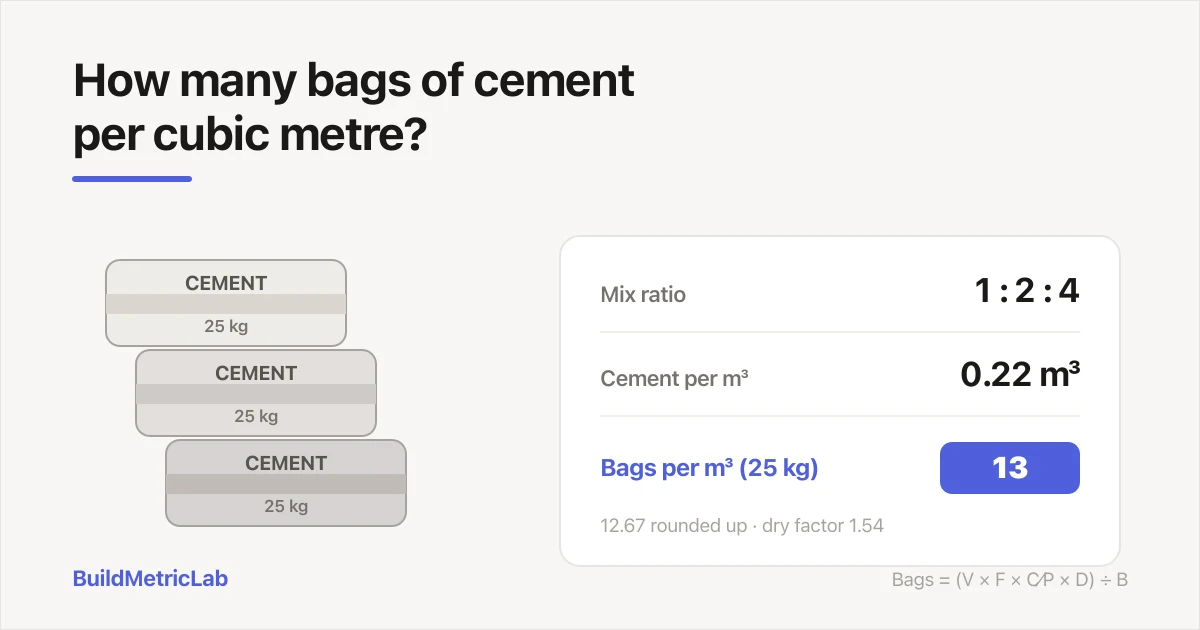
The cement bags calculator settles it in one step. This guide walks through the arithmetic sitting underneath it, so you can check the number on screen rather than take it on trust. Everything is worked in metric with imperial equivalents in brackets, and there is a table covering every bag size in common use — 20 kg through to the 94 lb sack — because a count that means one thing in Manchester means something quite different in Manitoba.
What a cement bag count actually tells you
A bag count is simply the number of whole bags that supply the cement portion of a given volume of concrete. Concrete is cement, sand and coarse aggregate — stone, gravel or metal, depending on where you are standing — combined in a fixed ratio, plus water. Once the ratio is fixed, the cement share follows from it directly.
Two things stop that being a one-line sum. Loose dry ingredients take up noticeably more space than the finished pour does, so you cannot batch a cubic metre of concrete from a cubic metre of dry material. And cement is sold by mass, not volume, so somewhere in the middle you need a density figure to move between the two.
Water sits outside the ratio. A 1:2:4 mix says nothing about how much water goes in, and that is a separate decision with a bigger effect on the finished strength than most people expect. More on that below.
Why the bag count is worth getting right
Under-ordering causes two distinct problems, and they are worth keeping apart in your head.
The first is a weak batch. If the cement runs low and someone quietly stretches the last few mixes, the ratio drifts leaner than specified and the concrete in that section is simply not the concrete on the drawing. The second is a cold joint: run out entirely, and the pour halts while someone drives to a merchant. The section already placed starts to stiffen, and the join between old and new concrete never bonds as well as a continuous pour would.
It is also worth being clear about what the bag count does and does not control. Cement content matters, but compressive strength is governed chiefly by the water-to-cement ratio, along with compaction and curing. Adding water on site to make a stiff mix easier to move is the fastest way to lose strength that a correct bag count was meant to deliver.
Then there is the market problem. Bag mass varies enormously by country, so a count quoted in one place rarely transfers to another.
The UK and Ireland mostly retail 25 kg (55 lb); Australia and New Zealand favour 20 kg (44 lb). Much of Asia, Africa, the Middle East and Latin America works in 50 kg (110 lb), and Canada in 40 kg (88 lb). The United States sells plain Portland cement in 47 lb and 94 lb sacks. A figure of "13 bags per cubic metre" with no bag size named is telling you nothing at all.
How to work out bags of cement per cubic metre
Start with the wet volume — the finished volume of concrete sitting in place. Multiply that by a dry volume factor, because loose ingredients bulk up before water and compaction close the voids between the grains. The concrete mix ratio then sets the cement share, a bulk density converts that share into mass, and the bag mass turns mass into a count.
Bags = (V × F × (C ÷ P) × D) ÷ BWhere:
- V = wet volume of the pour, m³ (cu ft or cu yd)
- F = dry volume factor, dimensionless, typically 1.52 to 1.57
- C = cement parts in the mix ratio
- P = total parts in the mix ratio
- D = bulk density of loose cement, taken here as 1440 kg/m³ (89.9 lb/cu ft)
- B = bag mass, kg (lb)
A 1:2:4 mix carries one part cement in seven parts total. At F = 1.54 and 25 kg (55 lb) bags, one cubic metre works out at 12.67 bags. Rounding always runs upward, never to the nearest whole — you cannot buy two-thirds of a bag, and a short batch cannot be fixed once the pour is underway. So 12.67 becomes 13, and 16.13 becomes 17 rather than 16.
A worked example: how many bags of cement per cubic metre
Take the garage base from the opening. It is poured as a 1:2:4 mix using 25 kg (55 lb) bags, with a 10% wastage allowance.
- Wet volume — 5 × 4 × 0.15 = 3 m³ (105.9 cu ft, or 3.92 cu yd)
- Dry volume — 3 × 1.54 = 4.62 m³ (163.2 cu ft)
- Cement share — 4.62 ÷ 7 = 0.66 m³ (23.3 cu ft)
- Cement mass — 0.66 × 1440 = 950.4 kg (2,095 lb)
- Theoretical bags — 950.4 ÷ 25 = 38.02
- With wastage — 38.02 × 1.10 = 41.82, rounding up to 42 bags
Drop the allowance to 5% and you get 39.92, which still rounds to 40 bags. Buying 50 kg (110 lb) bags instead gives 19.01 before wastage and 20.91 after, so 21 bags. Same concrete, same site, half the bag count — which is exactly why the bag size has to be stated alongside any figure.
The same run also tells you what else to order. The dry volume splits two parts sand and four parts aggregate, so this base needs 1.32 m³ (46.6 cu ft) of sand and 2.64 m³ (93.2 cu ft) of coarse aggregate.
Expressed per unit volume, that mix gives 12.67 bags per cubic metre, or 9.69 bags of cement per cubic yard.
If the volume itself is still unsettled, the guide on how much concrete you need for slabs and footings covers sizing the pour first. Where the ratio is the open question, the concrete mix ratio calculator shows how the split shifts across nominal mixes, and for anything that is not a simple rectangle the concrete slab calculator derives the volume from slab dimensions.
Every common bag size, side by side
All figures below are for a 1:2:4 mix at F = 1.54 and D = 1440 kg/m³, rounded up to whole bags. Multiply or divide proportionally for a richer or leaner ratio.
| Bag size | Where it is common | Bags per m³ | Bags per cu yd |
|---|---|---|---|
| 20 kg (44 lb) | Australia, New Zealand, UK retail | 15.84 → 16 | 12.11 → 13 |
| 47 lb (21.3 kg) | United States, retail Portland cement | 14.86 → 15 | 11.36 → 12 |
| 25 kg (55 lb) | UK, Ireland, much of Europe | 12.67 → 13 | 9.69 → 10 |
| 40 kg (88 lb) | Canada, parts of Europe and Australia | 7.92 → 8 | 6.06 → 7 |
| 94 lb (42.6 kg) | United States, trade supply | 7.43 → 8 | 5.68 → 6 |
| 50 kg (110 lb) | India, South East Asia, Africa, Middle East, Latin America | 6.34 → 7 | 4.84 → 5 |
As a sanity check on the whole method: Quikrete's own product data sheet puts five to six 94 lb bags of Portland cement, with appropriate sand and gravel, at one cubic yard of concrete. The table gives 5.68, rounding up to 6. The arithmetic and the manufacturer agree.
Pre-blended concrete mix is a different calculation entirely
The 40 lb, 60 lb and 80 lb bags stacked at every North American home centre are not plain cement. They are pre-blended concrete mix — cement, sand and aggregate already combined — and they are sold by the volume of finished concrete they yield, not by cement content. None of the arithmetic above applies to them.
For those, divide the pour volume by the yield printed on the sack. At the usual published yields, a cubic metre takes roughly 118 bags at 40 lb, 79 at 60 lb, or 59 at 80 lb. Per cubic yard that is 90, 60 and 45. The gap between 6 bags and 45 bags for the same cubic yard is exactly why the distinction is worth settling before anyone loads a trolley.
How to use the cement bags calculator
The cement bags calculator takes four inputs: the pour volume or its dimensions, the mix ratio, the bag mass and a wastage percentage. Volume accepts cubic metres or cubic yards, and dimensions accept millimetres, metres, inches or feet.
It returns the total cement mass, the whole bag count after rounding, and the sand and aggregate volumes that go with it. Wastage is already folded into the bag count, so the number on screen is an order quantity rather than a theoretical requirement — no need to add a margin on top of it a second time.
Common scenarios
Domestic slabs and garage bases
Slabs for garages, sheds and patios typically sit between 100 mm (3.9 in) and 150 mm (5.9 in) thick and commonly use a 1:2:4 mix. That comes to 13 cement bags per cubic metre at 25 kg (55 lb), or 10 per cubic yard. At 50 kg (110 lb) it is 7 and 5.
Strip foundations and mass fill
Foundations carry load through bulk rather than surface strength, so leaner ratios such as 1:3:6 are common. That works out at 8.87 bags per cubic metre in 25 kg bags, rounding to 9, or 6.78 per cubic yard, rounding to 7.
Posts, bedding and haunching
Setting posts and bedding kerbs involves volumes under 0.1 m³ (3.5 cu ft), where a fast-setting post mix often replaces a site batch entirely. Where you are still mixing, the mortar calculator covers bedding and haunching, which follow a different ratio convention from concrete.
Common mistakes
- Skipping the dry volume factor — treating one cubic metre of finished concrete as one cubic metre of dry ingredients understates the cement by about 35%.
- Quoting a count without a bag mass — "13 bags" is meaningless until the bag size is stated, and standard bag masses vary two and a half times over worldwide.
- Confusing cement with pre-blended mix — a bag of ready-blended concrete already contains its aggregate, so its yield is nothing like a bag of straight cement.
- Mixing unit systems — a thickness in inches multiplied by a length in metres produces a volume no wastage allowance can rescue.
- Omitting wastage — spillage, part bags and uneven substrate all consume material the theoretical figure ignores.
Sources and methodology
The method above is nominal volume batching — the traditional site approach in which proportions are set by parts rather than by tested performance. The 1440 kg/m³ (89.9 lb/cu ft) bulk density for loose Portland cement and the 1.52 to 1.57 dry volume factor range are long-standing estimating conventions rather than values fixed by any single code, and they are presented here as such.
Worth knowing: modern concrete standards have largely moved away from nominal ratios in favour of designed and prescribed mixes specified by strength class, exposure class and constituent limits. EN 206 across Europe and the ACI 211 family in North America both work this way. Where a drawing gives a strength class, that specification takes precedence over any nominal ratio, and the arithmetic here becomes a rough ordering check rather than a design method.
- Portland Cement Association — technical guidance on cement properties, bag conventions and mix proportioning.
- American Concrete Institute — publisher of ACI 211, the standard practice for selecting proportions for normal concrete.
- ISO concrete and concrete product standards (ICS 91.100.30) — constituent proportioning and conformity, independent of any national code.
Building regulations and codes are national, and the one that governs your pour is the one in force where you are building. Nothing above substitutes for it.
Putting it together
How many bags of cement per cubic metre a pour needs comes down to three numbers that are easy to state and easy to get wrong: the mix ratio, the dry volume factor and the bag mass. Pin those three down and the arithmetic stops being a guess. A 1:2:4 mix in 25 kg (55 lb) bags takes 13 bags per cubic metre, or 10 bags of cement per cubic yard, before any wastage allowance goes on top.
The cement bag quantity calculator runs the same formula for any ratio, bag size and volume, in whichever units your merchant quotes in. That leaves the specification itself as the only judgement call left in the order.
Frequently asked questions
How many bags of cement do I need per cubic metre of concrete?
For a 1:2:4 mix in 25 kg (55 lb) bags, one cubic metre takes 12.67 bags, rounding up to 13. Richer mixes need more: 1:1.5:3 works out at 16.13, rounding to 17. Leaner mixes need fewer, with 1:3:6 giving 8.87, rounding to 9. All of those assume a dry volume factor of 1.54 and a cement bulk density of 1440 kg/m³ (89.9 lb/cu ft). Bag size changes the count in direct proportion, so 20 kg (44 lb) bags lift the 1:2:4 figure to 15.84, rounding to 16, while 50 kg (110 lb) bags bring it down to 6.34, rounding to 7.
How many bags of cement are in a cubic yard of concrete?
A cubic yard is 0.7646 cubic metres, so any metric figure scales by that factor. A 1:2:4 mix in 25 kg (55 lb) bags gives 9.69 bags of cement per cubic yard, rounding up to 10. The underlying cement mass is 242.2 kg (534 lb) per cubic yard regardless of how it is packaged. Divide that mass by whichever bag is on the shelf: 47 lb sacks give 11.36, rounding to 12, and 94 lb sacks give 5.68, rounding to 6, which matches Quikrete's published guidance of five to six bags per cubic yard. One warning — 40 lb, 60 lb and 80 lb North American bags are pre-blended concrete mix, not cement, and are counted by yield instead.
What is the dry volume factor and why is it 1.54?
The dry volume factor accounts for the space between loose dry particles that water and compaction later close up. Sand and aggregate arrive with voids between the grains, cement paste fills those voids during mixing, and the finished concrete therefore occupies less space than its ingredients did separately. Published values sit between 1.52 and 1.57 depending on aggregate grading and moisture content, and 1.54 is the figure most widely used as a working average. It is a convention rather than a measured constant, so treat it as an estimating tool. The factor applies to the wet volume before the ratio is split out, which means omitting it understates sand and aggregate just as much as cement.
Does a mix ratio refer to volume or mass?
Ratios written as 1:2:4 or 1:3:6 are volume ratios unless a specification says otherwise, and the method above assumes volume throughout. Batching by mass gives tighter control and is standard for ready-mixed supply, where plants work to a designed strength class rather than a nominal ratio. Site batching by volume uses gauge boxes or bucket counts, which is why nominal ratios persist in practice. Converting between the two needs bulk densities for all three constituents, not cement alone. Where a drawing specifies a strength class, a nominal ratio is a substitute rather than an equivalent.
Why do North American cement bag counts look so different?
Two reasons, and they compound. First, the traditional 94 lb sack was sized around one cubic foot of loose cement, which implies a density near 1506 kg/m³ (94 lb/cu ft) rather than the 1440 kg/m³ (89.9 lb/cu ft) used across most metric estimating. The figures here treat 94 lb purely as a bag mass, which is the safer reading. Second, much North American bagged product is pre-blended concrete sold by finished yield, not plain cement. Comparing a yield figure with a batching figure produces answers that differ by several times over.