· Concrete & Foundations
How Much Concrete Per Fence Post? Volume, Bags and Depth
How much concrete per fence post is a subtraction problem: hole volume minus the post and the gravel bed, plus a wastage allowance. This guide gives the formula, a worked example in metric with imperial equivalents, bag yields for both 20 kg and 50 lb markets, and the cases where the four-bag rule of thumb stops holding.
One 100 mm (3.9 in) square post, standing in a 300 mm (11.8 in) hole dug 600 mm (23.6 in) deep, takes about four bags of fast-set mix. That is the answer most people are after, and it holds for a large share of domestic fences anywhere in the world. What it does not tell you is what happens when the auger is a size larger, the ground freezes in winter, or the run ends at a gate — and those are the cases where an estimate quietly goes wrong.
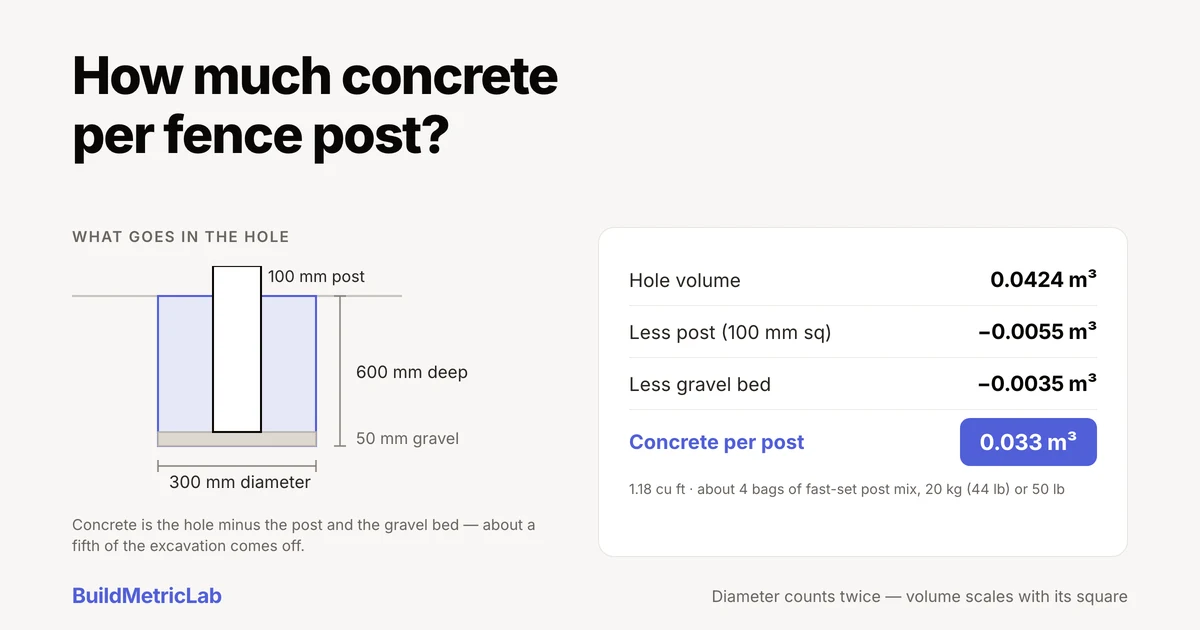
Working out how much concrete per fence post is a subtraction problem rather than a volume problem. You start with the hole, take away the things sitting inside it, and add a margin for what ends up on the ground instead of in the mix. The post hole concrete calculator runs the whole thing for any hole size — millimetres and kilograms on the UK page, inches and pounds on the US one — but the arithmetic is worth seeing once, because it explains why some changes barely move the number and others move it enormously.
What the concrete figure actually measures
The number you want is the placed volume: the part of the hole that ends up full of concrete, not the volume of the hole itself. Two things occupy space and come off the total. The first is the buried length of the post. The second is any gravel, crushed stone or hardcore bed laid underneath it, which is common practice in wet ground because it lets water drain away from the timber rather than pool against the end grain.
What remains after those subtractions is quoted in cubic metres or cubic feet, and it is the figure that converts into a bag count or a delivery. In a typical domestic hole the post and the gravel bed together account for a little over a fifth of the excavation — 21 per cent in the example below — so treating the hole volume as the concrete volume overshoots the real requirement by about 27 per cent.
Why the figure matters on site
Fast-set post mix is bought in whole bags and ready-mixed concrete arrives in whole loads, so an estimate that lands close keeps the job moving. Running short partway through a run is the expensive failure: fast-set concrete has a working life measured in minutes, so a trip to the merchant means the posts already set are fine and the ones half-poured are not.
The same geometry does a second job. Hole diameter and depth determine the auger or shovel size, the spoil that has to be carted away, and how much of the garden ends up under a tarpaulin. Sizing the concrete and sizing the excavation are the same calculation read two ways.
How concrete per post is calculated
Most post holes are cylindrical, whether they are augered or dug by hand, so the gross volume is the area of a circle multiplied by the depth. Subtract the part of the post that sits inside the hole and the gravel bed beneath it, and what is left is concrete. Multiply by the number of posts, then add a wastage allowance.
Gross hole volume  = π × (D / 2)² × H
Gravel bed volume  = π × (D / 2)² × G
Post embedment     = H − G
Post displacement  = A × (H − G)
Concrete per post  = Gross − Post displacement − Gravel bed
Order volume       = Concrete per post × N × (1 + waste)
Where:
- D = hole diameter, in metres (feet)
- H = hole depth, in metres (feet)
- G = depth of the gravel drainage bed, in metres (feet)
- A = cross-sectional area of the post — width × breadth for a square or rectangular post, π × (w / 2)² for a round one
- N = number of posts in the run
- waste = wastage allowance as a decimal, commonly 0.05 to 0.10
The detail that trips people up is the H − G term. Where a gravel bed is used, the post sits on top of it, so the post is not embedded to the full depth of the hole. A 600 mm hole with a 50 mm bed gives 550 mm of post inside the concrete, not 600 mm. Get those two mixed up and every figure downstream is out.
A worked example: how much concrete per fence post
A 1.8 m (5.9 ft, the standard 6 ft panel height) fence runs across a garden on twelve posts. Each post is 100 mm (3.9 in) square. The holes are augered to 300 mm (11.8 in) diameter and 600 mm (23.6 in) deep, with a 50 mm (2 in) gravel bed in the bottom — leaving 550 mm (21.7 in) of post surrounded by concrete.
Gross hole volume: π × 0.15² × 0.6 = 0.0424 m³ (1.50 cu ft).
Post displacement: 0.1 × 0.1 × 0.55 = 0.0055 m³ (0.19 cu ft).
Gravel bed: π × 0.15² × 0.05 = 0.0035 m³ (0.12 cu ft).
Concrete per post: 0.0424 − 0.0055 − 0.0035 = 0.033 m³ (1.18 cu ft).
Across twelve posts that is 0.401 m³ (14.1 cu ft). Adding a 10 per cent wastage allowance gives 0.44 m³ — 15.6 cu ft, or 0.58 cu yd — as the figure to order against. At a yield of 0.010 m³ (0.35 cu ft) per 20 kg (44 lb) bag, that is 45 bags.
Two routes to the same job give slightly different bag counts, and both are defensible. Ordering against total volume gives 45 bags. Rounding up per post — 3.3 bags each becomes 4 — gives 48. The per-post route is what most installers do, because a part bag of fast-set mix cannot be resealed and kept for the next hole. The gap between 45 and 48 is the wastage allowance showing up in physical form.
Running the same inputs through the post hole concrete calculator returns both the volume and the bag count, and the fence calculator settles the post spacing that fixes N in the first place.
How to use the post hole concrete calculator
The post hole concrete calculator takes six figures: the number of posts, the hole diameter, the hole depth, the post width, the bag size and the price per bag. It returns the concrete per hole, the total volume for the run, the number of bags and an estimated cost. The UK page works in millimetres and kilograms and the US page in inches and pounds, so open the one that matches the units you are already reading off the drawing or the merchant's listing rather than converting by hand.
Three things it has no input for, and how to handle each:
- The gravel bed. Enter the concrete depth rather than the hole depth — hole depth minus the bed. Because the post sits on the bed, that single subtraction removes the bed and corrects the embedment at the same time, and the result comes out identical to the full formula above. The worked example goes in as 550 mm, not 600 mm.
- Wastage. The bag count is the bare requirement with no margin in it, so add 5 to 10 per cent yourself — either to the volume you order against, or by rounding up per post the way most installers do.
- Round posts. Post width is read as a square section. For a round post, enter 0.886 × its diameter — 89 mm for a 100 mm post — and the displaced volume comes out right.
Putting the worked example in — twelve posts, 300 mm diameter, 550 mm of concrete depth, 100 mm posts, 20 kg bags — returns 0.03 m³ per hole, 0.40 m³ for the run and 46 bags. The tool works to roughly 0.011 m³ of placed concrete per 25 kg of bagged mix, pro-rated to the bag size you enter, so a product with a different printed yield will shift the bag count while leaving the volume alone. The volume is the figure to carry to the merchant; the bag count is a check against it.
Turning volume into bags, wherever you are
Bag formats differ by market, and the yield printed on the bag is what governs — not a generic average, because manufacturers vary. The two dominant formats land in much the same place:
- 20 kg (44 lb) bags, common across the UK, Ireland, Europe, Australia and New Zealand, generally place somewhere between 0.009 and 0.011 m³ (0.32 to 0.39 cu ft). At 0.010 m³ the worked example needs 3.3 per post.
- 50 lb (22.7 kg) bags, the standard North American format, are commonly stated at around 0.375 cu ft (0.0106 m³). The same hole needs 3.1 per post.
- 10 kg and 25 kg bags also appear in various markets, generally at proportional yields.
Both routes round up to four bags a post, which is why the four-bag rule of thumb survives translation between markets. Fast-set post mix, sold under a range of regional trade names, is the usual product for this job because it goes off in minutes rather than hours and needs no separate mixing.
Ready-mixed concrete is a different question at this scale. A run of 0.44 m³ (0.58 cu yd) sits well below the minimum load most suppliers will deliver, and part loads carry a minimum charge that makes bags cheaper for anything domestic. Ready-mix starts to earn its place on long boundary runs or heavy commercial fencing, where the ready-mix truck volume calculator gives the load count. Site-batched mixes are different again: those need cement, sand and aggregate worked out separately, which the cement bags calculator handles. For slabs and footings rather than post holes, how much concrete do I need works the same subtraction from the other end.
Common scenarios
Standard garden and yard fencing
Panel fences on 100 mm (4 in) posts at roughly 1.8 m (6 ft) centres sit very close to the worked example. The figure is stable enough that many installers price by the post rather than by volume and never open a calculator twice for the same job.
Gate posts and end posts
A gate post carries swing loads that a line post never sees, so it usually gets a heavier section in a wider, deeper hole. This is where estimates break down, because volume scales with the square of the diameter. Doubling the hole from 300 mm to 600 mm, with a 150 mm post in it, takes the concrete from 0.033 m³ to about 0.14 m³ — more than four times as much, even after the bigger post displaces more. Two gate posts in double-diameter holes can therefore swallow as much mix as eight or nine line posts, which is worth pricing separately rather than folding into a per-post average.
Soft, made or sloping ground
On made ground, peat, reclaimed land or a slope, holes are commonly deepened and the specification referred to an engineer. The arithmetic does not change, but the inputs stop being predictable, so it is worth recalculating rather than scaling the standard figure.
Cold climates and frost depth
Where the ground freezes, the base of the concrete normally sits below the local frost line so that heave cannot lift the post through the winter. Frost depths of 1.2 m (4 ft) and beyond apply across much of Canada, the northern United States, Scandinavia and continental Europe, and published frost-depth maps or local codes give the governing figure. The volume consequence is direct: taking the same 300 mm hole from 600 mm to 1.2 m deep roughly doubles the concrete per post, from 0.033 m³ to 0.070 m³.
Round posts
Round timber posts displace less concrete than a square post of the same nominal width — a 100 mm round post has about 79 per cent of the cross-section of a 100 mm square one — so the concrete figure rises slightly for the same hole. Entering 0.886 × the round post's diameter as the post width reproduces that displacement in the calculator.
Common mistakes
- Ordering against gross hole volume. The post and the gravel bed together remove about a fifth of a typical domestic hole. It errs on the generous side, so a run rarely stops short — but the surplus is concrete that gets paid for and never leaves the bag.
- Using hole depth as post embedment. Where a gravel bed is used, the post sits on it. A 600 mm hole with a 50 mm bed embeds the post 550 mm, and using 600 mm understates the concrete needed.
- Skipping the wastage allowance. Spillage, oversized holes, collapsed sides and part bags typically account for 5 to 10 per cent across a run — more if the ground is loose. No calculator adds this for you unless it says so.
- Mixing units mid-calculation. Because the diameter is squared, a unit slip in that term compounds. Entering a diameter of 11.8 in as though it were 11.8 m throws the answer out by more than a thousand times, and the intermediate figures still look like numbers. The metric page works in millimetres throughout, so a 300 mm hole is entered as 300, not 0.3.
- Estimating cement rather than concrete. Cement is one ingredient. A site-batched mix needs cement, sand and aggregate proportioned separately, which is a different calculation entirely.
Sources and methodology
The volume method above is pure geometry and holds in any market; every figure in the worked example was calculated from first principles. Embedment practice, frost depth and the durability requirements for concrete placed in contact with ground are set locally, and the references below cover the principles rather than any single jurisdiction's numbers.
- The Concrete Centre — technical guidance on concrete mixes, placing and durability
- American Concrete Institute — international standards for concrete practice and durability
- Eurocode 2: Design of concrete structures (EN 1992), as an example of a regional design standard — check your local equivalent
National codes such as the UK Approved Documents, the International Residential Code in North America, or the Australian Standards apply as examples of local requirements rather than universal rules. Frost depth in particular is set by regional mapping and has no international default.
Putting it together
Concrete per post is four moves: take the cylinder, remove the post, remove the gravel, add wastage. The worked example lands at 0.033 m³ (1.18 cu ft) per post and 0.44 m³ across a twelve-post run, and those same inputs drive every variation on the theme — gate posts, frost-line embedment, round timber, soft ground. Diameter is the input to watch, because it enters the formula squared and moves the answer faster than anything else. A change of auger size is worth putting through the numbers again rather than estimating from the last job.
Frequently asked questions
How much concrete does one fence post need?
A common domestic post — 100 mm (3.9 in) square, set in a 300 mm (11.8 in) diameter hole dug 600 mm (23.6 in) deep — takes roughly 0.033 m³ (1.18 cu ft) of placed concrete once the post and a 50 mm gravel drainage bed are subtracted. That works out at about four bags of fast-set post mix, whether you are buying 20 kg (44 lb) bags or 50 lb North American ones. Wider holes push the figure up quickly, because volume scales with the square of the diameter, so a change of auger size is worth recalculating rather than eyeballing.
How deep should a fence post hole be?
A widely used rule of thumb puts embedment at around a third of the post height standing above ground, with 600 mm (23.6 in) treated as a practical floor for a 1.8 m (6 ft) fence. Exposed sites, soft ground and taller panels commonly call for more, and local building regulations or codes may set their own minimums that override the habit. Frost depth matters too: in colder regions the base of the concrete normally sits below the local frost line so heave cannot lift the post. Embedment is worth settling against local guidance before any concrete is ordered, because volume follows directly from depth.
How many bags of concrete per fence post?
Bag counts come from placed volume divided by the yield printed on the bag. A 20 kg (44 lb) bag of fast-set post concrete generally places somewhere around 0.010 m³, so the 0.033 m³ example needs about 3.3 bags and rounds to four. A 50 lb (22.7 kg) North American bag is commonly stated at 0.375 cu ft, giving 3.1 bags for the same hole and rounding to four as well. Yields differ between manufacturers, so the product datasheet governs. Because a part bag of fast-set mix cannot be kept once opened, rounding up per post and treating the surplus as wastage is standard practice on site.
Is a wider hole or a deeper hole better for a fence post?
The two do different work. Depth increases the lever arm resisting rotation, which is how a fence post typically fails — it turns about a point near the base rather than sinking straight down. Width mostly increases the concrete consumed, though a collar of around 75 mm (3 in) of mix on every face is commonly specified so the concrete can flow and consolidate properly around the post. From an estimating point of view the asymmetry is stark: doubling the depth roughly doubles the volume, while doubling the diameter roughly quadruples it. Local codes and ground conditions determine what is actually appropriate, so this is a question about cost consequences rather than a substitute for a specification.
Related calculators
Sources
- The Concrete Centre — technical guidance on concrete mixes, placing and durability
- American Concrete Institute — international standards for concrete practice and durability
- Eurocode 2: Design of concrete structures (EN 1992), as an example of a regional design standard — check your local equivalent