· Concrete & Foundations
Cement bags calculator: concrete volume to bags
A cement bags calculator converts a concrete volume into a whole bag count and an estimated cost. This guide covers the method, a worked example, and common mistakes.
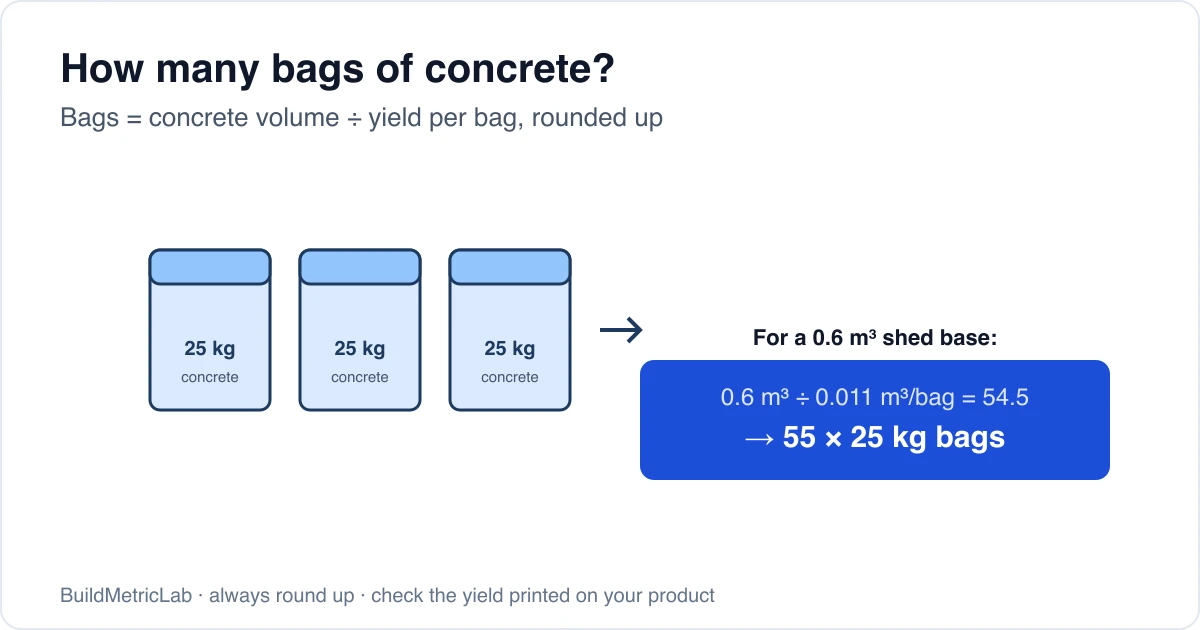
A shed base three metres by two at 100mm thick comes to just 0.6 cubic metres (about 21 cubic feet) of concrete. It sounds like nothing. Then you work it out properly and find you need 55 bags of mix. Get that figure wrong and one of two things happens: the pour stalls halfway while someone makes a panic run to the merchant, or you end up with a stack of part-used bags going off in the rain behind the garage. A cement bags calculator settles it in a few seconds, turning a concrete volume into a whole bag count and a rough cost. This guide walks through what the tool does, the sums behind it, and a full worked example, so whether you are pricing a job or planning your own weekend pour, you can order once and order right.
What a cement bags calculator does
The tool does one job: it converts a volume of concrete into the number of bags it takes to fill that volume. You enter the volume in cubic metres (or cubic feet), choose a bag size, add a price per bag, and it hands back a whole bag count and an estimated total. It is built for the way most small jobs run, where a pre-blended bagged mix gets turned over in a wheelbarrow or a small mixer rather than turning up on a lorry.
One thing worth clearing up early. People search for "cement" bags, but the figure here is bags of concrete mix, which already has the cement and aggregate blended in. The calculator handles the conversion using a yield per bag, then rounds up, because no merchant sells you three-quarters of a bag. Treat the result as a shopping list, not a structural drawing.
Why it matters for concrete work
Running short mid-pour is one of those quiet site problems that costs more than it looks. Concrete that starts to cure because the next batch arrived twenty minutes late will not bond cleanly with what follows, and you are left with a weak cold joint running through the slab. A bag count that is right first time keeps the pour continuous and the finish sound.
Then there is the money. Materials prices have moved around a fair bit lately, and national construction-materials price indices track the month-by-month moves on cement, aggregates and concrete products. When unit prices shift, a tight bag count keeps a quote honest, which is why most estimators rebuild the number for each job instead of pulling an old figure off the last one.
There is a catch, and it is an important one: quantity is only half the picture. Anything that carries load — footings, foundations, a structural slab — falls under your local building regulations and national structural standards (in the UK, for example, Approved Document A of the Building Regulations), and the depth, mix and reinforcement are questions for a qualified professional. A bag count tells you how much to buy. It says nothing about what the element has to hold up.
How the calculation works
Once you know the volume, the maths is simple. The calculator divides the concrete volume you enter by what one bag yields when mixed, then rounds up to the next whole bag. The cost is just the bag count times the price per bag. There is no separate wastage field, so fold any spillage allowance into the volume before you enter it.
bags = round_up( volume_m3 ÷ yield_per_bag_m3 )
total_cost = bags × price_per_bag
Where:
- volume_m3 — the finished concrete volume in cubic metres (length × width × thickness, everything in metres), with any wastage margin already added
- yield_per_bag_m3 — the mixed volume one bag makes, printed on the product, roughly 0.011 m³ (about 0.39 cu ft) for a typical 25kg (55 lb) bag; bag weights and yields differ by country, so read the figure on the product
- price_per_bag — the merchant price for a single bag, which the tool fills with an illustrative figure you can swap for a live quote
The rounding up is on purpose. A spare bag or two keeps the pour moving; rounding down just invites you to run dry halfway through the mix. A sensible wastage margin, somewhere around 5 to 10 per cent added to the volume, covers spillage, over-dig and an uneven base.
A worked example with real numbers
Priya is laying a base for a garden workshop. The slab is 3.0m long (about 10ft), 2.0m wide (6ft 6in) and 100mm (4in) thick, and she has settled on 25kg (55 lb) bags of general-purpose concrete. Assume a bag price of P in your local currency, before any local sales tax or VAT.
Start with the volume. Three by two by 0.1 gives 0.6 m³ (about 21 cu ft) of concrete — the figure the calculator works from.
Now the bags. The tool divides 0.6 by a 25kg yield of 0.011 m³, giving 54.5, and rounds up to 55 whole bags. The materials cost is simply the bag count times the price you pay: 55 × P, whatever a bag costs at your local merchant.
Put a volume of 0.6 m³ into the cement bags calculator with your own bag price and it returns the same 55 bags and the matching total, so the figures tie up. That 55 is the bare conversion: the calculator has no wastage field, so for a real order add a margin to the volume first — bumping 0.6 to around 0.66 m³ to cover spillage and an uneven sub-base nudges the count up by a few bags. The result rests on the stated yield, and a different product or bag size moves it, which is exactly why the coverage printed on your chosen bag is the figure to check before you order.
How many bags by volume
The table below turns a finished concrete volume into a whole-bag count for the two common bag sizes, with any wastage margin already folded into the volume.
| Concrete volume | 20 kg bags | 25 kg bags |
|---|---|---|
| 0.10 m³ (0.13 cu yd) | 12 | 10 |
| 0.25 m³ (0.33 cu yd) | 28 | 23 |
| 0.50 m³ (0.65 cu yd) | 56 | 46 |
| 0.75 m³ (0.98 cu yd) | 84 | 69 |
| 1.00 m³ (1.31 cu yd) | 112 | 91 |
How to use the cement bags calculator
There are three inputs. Concrete volume goes in as cubic metres, so a thickness you have measured in millimetres (or inches) needs converting to metres first, as in the example above. Bag size is set in kilograms, with 20kg and 25kg the two sizes most common in the UK and Europe; in North America and elsewhere you will also see pound-based bags, typically 60 lb and 80 lb (about 27 and 36 kg), so check the weight and printed yield on the product you actually buy. Price per bag comes pre-filled with an illustrative default, which you can overwrite with a supplier quote in your own currency.
With those in, the cement bags calculator gives you the whole bag count and an estimated total. Change the bag size or the volume you enter and the result updates straight away, which makes it quick to weigh a couple of products against each other. The output is an estimate based on what you enter, and the real figure varies with site conditions and the exact product.
Common scenarios
Setting fence posts
A run of fence posts is a lot of little concrete collars, not one slab. Work out the volume of a single post hole, multiply by the number of posts, and you have a total the tool can turn into bags. Rapid-set post-mix products have their own coverage, so the printed yield matters even more than usual here.
A small shed or workshop base
A few square metres at 100mm thick, like Priya's slab, sits right in bagged-mix territory. The bag count stays sensible, hand-mixing or a small mixer is realistic, and the calculator keeps the order tight. For a thicker base going over reinforcement, it is worth checking the figure against a structural detail rather than just the volume.
Bags versus a delivery
Once a job creeps towards a cubic metre (around 1.3 cubic yards) or more, it is worth comparing the bagged total against a ready-mixed quote. Working out the bag count first gives you a clean like-for-like number to set beside a delivered price, part-load charge and all.
Common mistakes
- Mixing up units — logging thickness in millimetres but length in metres throws the volume out by a factor of a thousand. Get everything into metres before you multiply.
- Using cement yield for concrete — a bag of cement is not a bag of concrete, and a cement-only figure undercounts badly. Check whether the product is pre-blended concrete or just cement.
- Forgetting wastage — enter the exact theoretical volume and you leave nothing for spillage or an uneven base. Pad the volume by 5 to 10 per cent first, because a pour that runs short starts curing before the shortfall turns up.
- Trusting a generic yield — coverage varies between products, so a default is a starting point, not gospel. The yield printed on your chosen bag is the figure to order against.
Related calculations and tools
A concrete job rarely ends at the bag count. These BuildMetricLab tools cover what sits around it:
- concrete wall calculator — estimate volume for walls and retaining structures before you convert to bags
- rebar calculator — work out reinforcement quantities for slabs and footings
- concrete steps calculator — break a stepped pour into measurable volumes
Pairing the cement bags calculator with a volume tool for the element keeps the whole estimate consistent.
Sources and methodology
The conversion works from a finished concrete volume and a per-bag yield taken from typical bagged-product coverage, with whole-bag rounding. The figures in this article were checked by hand and cross-checked against the calculator output for the same inputs. Yield and price are illustrative and vary by product and supplier.
- Bag coverage and mix yield — manufacturer technical data (example: Quikrete Concrete Mix)
- Concrete fundamentals and mix proportions — Portland Cement Association
- Structural design of concrete — national code example (Eurocode 2, EN 1992-1-1)
The bottom line
A good concrete order starts with a clean volume and a realistic yield, and a cement bags calculator turns those into a whole bag count and a cost estimate without the back-of-an-envelope risk. Check the coverage printed on the product you are buying, pad the volume for a sensible wastage margin, and reconcile the figure before the merchant run. For anything that carries load, the quantity is the easy part — the specification belongs with a qualified professional.
Frequently asked questions
How many 25kg bags of concrete are in a cubic metre?
As a rough guide, a 25kg (55 lb) bag of general-purpose bagged concrete yields about 0.011 m³ once it is mixed with water, which comes to roughly 91 bags per cubic metre (about 2.6 bags per cubic foot) before any wastage. The exact figure shifts by product, because the yield printed on the bag depends on the aggregate blend and how wet the mix is worked. A 20kg bag covers a little less, so you need a few more of them for the same volume. The cement bags calculator applies the yield for you and rounds up to whole bags. For an exact order, the coverage printed on your chosen product is the figure to trust.
What is the difference between cement, ballast and bagged concrete mix?
Cement is the grey powder that binds a mix, and on its own it is not concrete. Ballast is the sand and gravel blend, the aggregate that gives concrete its bulk and strength. Concrete is what you get once cement, ballast and water are combined in the right ratio and left to cure. A bagged concrete mix has the cement and aggregate pre-blended, so only water goes in on site. The cement bags calculator estimates whole bags of that pre-blended product from a finished volume, which is the most common DIY and small-job format. For bigger pours, buying cement and ballast separately, or ordering ready-mixed, often changes the sums.
When does ordering ready-mixed concrete make more sense than bags?
Bagged mixes suit small pours: fence posts, a shed base, a short path, anything you can turn over by hand or in a small mixer. As the volume climbs, the bag count and the graft of mixing climb with it, and a ready-mixed delivery from a batching plant can work out more practical and sometimes cheaper per cubic metre. Plenty of suppliers set a minimum load, often around a cubic metre (1.3 cubic yards), with part-load charges below that. A handy approach is to estimate the bag count and cost with the cement bags calculator, then ask for a delivered quote on the same volume and compare the totals, delivery and waiting time included.
How do I convert a slab measured in feet into cubic metres?
Measure length, width and thickness, then convert each to metres before multiplying. One foot is 0.3048 metres and one inch is 0.0254 metres. A slab that is 10ft by 6ft and 4 inches thick works out at 3.05m by 1.83m by 0.102m, or about 0.57 m³. Multiply the three metric figures together to get the volume in cubic metres, which is what the cement bags calculator expects. Keeping everything in metres avoids the classic slip of mixing units, which throws the bag count right out. Thickness is the one people most often jot down in millimetres, so remember that 100mm is just 0.1m.