· Concrete & Foundations
Water-Cement Ratio: Why It Decides Concrete Strength
The water cement ratio is the mass of mixing water divided by the mass of cement, and it governs concrete strength and durability more than any other single figure. This guide covers the formula, a metric worked example with imperial equivalents, the water figure for every common bag size, and the site habits that push the number too high.
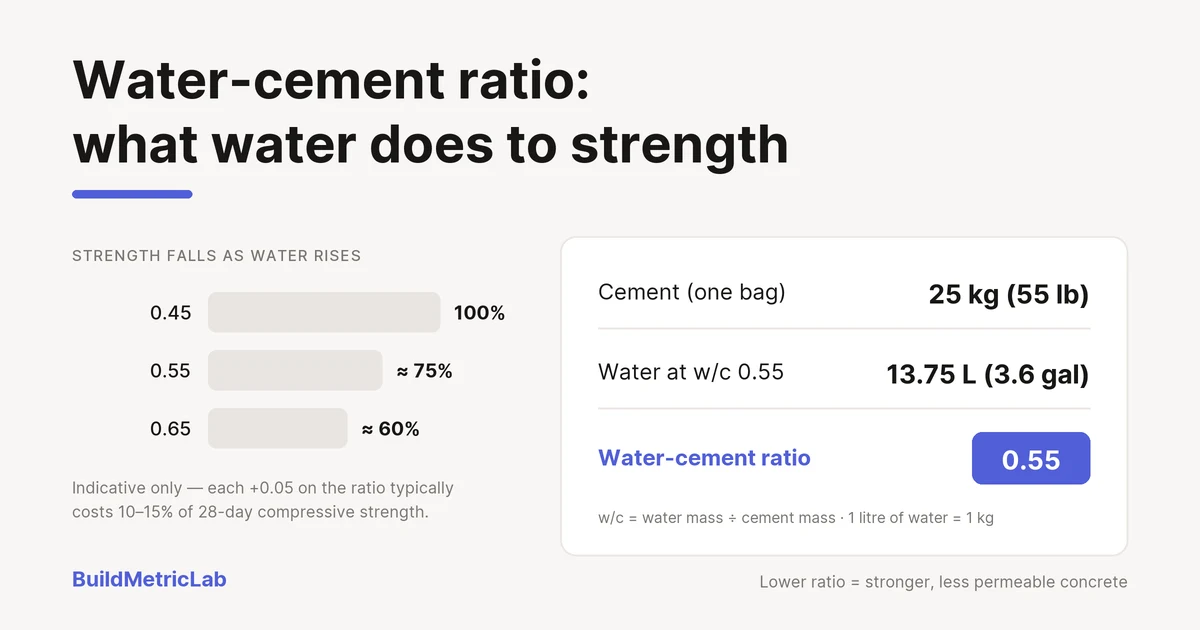
A slab tipped with two extra buckets of water to loosen it can shed a quarter of its design strength before it has finished setting. The water cement ratio — the mass of mixing water divided by the mass of cement — is the single number that governs how strong and how durable the finished concrete turns out, and the water-cement ratio calculator turns a cement mass and a water volume into that figure, with an indicative strength band for what the batch can reach.
What follows is the formula, a worked example in metric with imperial equivalents, the water figure for every common bag size, and the site habits that quietly push the ratio higher than the mix design allows.
What is the water cement ratio?
It is the mass of mixing water divided by the mass of cement in the same batch, written as a decimal. A batch holding 25 kg (55 lb) of cement and 13.75 kg of water sits at 0.55. Because one litre of water has a mass of one kilogram, litres and kilograms are interchangeable on the water side, which is what makes the figure workable on site rather than only on paper. Mixes below roughly 0.40 tend to be too stiff to place by hand without admixtures, and above roughly 0.60 strength and durability are traded away for ease of working.
Why the water cement ratio matters
Water not taken up by hydration does not disappear. It occupies space in the cement paste, and when it eventually evaporates it leaves a network of capillary pores behind. Those pores are what strength, permeability and frost resistance all hang on.
As a rule of thumb, each step of 0.05 upwards typically costs 10 to 15 per cent of compressive strength, and the losses compound. A mix designed at 0.50 and batched at 0.65 can land well below its specified class.
Durability follows the same curve. Exposure classes in concrete standards are written as maximum permitted ratios, because permeability drives chloride ingress, carbonation and freeze-thaw damage more directly than cement content alone does. That is why the limits tighten as the exposure gets harsher rather than as the loads get heavier.
| Work | Typical maximum w/c | What drives the limit |
|---|---|---|
| High-strength concrete, aggressive exposure | 0.40 and below | Strength and very low permeability; needs a plasticiser to stay placeable |
| Reinforced concrete in wet or freezing exposure | 0.45 – 0.50 | Keeping chlorides, carbonation and freeze-thaw out of the cover zone |
| General reinforced slabs and footings, sheltered | 0.50 – 0.55 | Balance of strength against being placeable by hand |
| Mass fill, blinding, non-structural work | 0.60 as a practical ceiling | Placeability matters more than strength, but the paste still has to set |
How the water cement ratio is calculated
Total the water going into the batch, total the cement, and divide the first by the second. The arithmetic is trivial; the accounting is where it goes wrong, because water arrives from more than one place. Moisture already sitting on damp sand and aggregate counts towards the total.
w/c = W / CWhere:
- W = total mass of water in the batch, kg (lb) — added water plus free moisture carried by the aggregate
- C = total mass of cement in the batch, kg (lb) — including any replacement such as fly ash or ground granulated blast-furnace slag, counted as the specification directs
- w/c = the ratio, dimensionless
Free moisture means water on the particle surfaces, over and above what the particles have absorbed. Damp sharp sand (US and Canada: concrete sand) commonly carries 3 to 6 per cent of its own mass that way.
A worked example
Priya is casting a workshop base of 3.0 m (9.84 ft) by 2.5 m (8.20 ft) at 100 mm (3.94 in) thick, so 0.75 m³ (26.5 cu ft, or 0.98 cu yd). Her specification calls for 320 kg/m³ (539 lb/cu yd) of cement at a maximum ratio of 0.55.
Cement first: 0.75 × 320 = 240 kg (529 lb). Total water at the design ratio: 0.55 × 240 = 132 litres (34.9 US gal). That is the ceiling for every drop in the batch, wherever it comes from.
Now the correction most site mixes skip. The coarse aggregate is taken as saturated-surface-dry, so it neither adds water nor soaks any up; her sand, stockpiled uncovered, carries 4 per cent free moisture. At 750 kg/m³ the batch takes 562.5 kg (1,240 lb) of sand, bringing 22.5 litres (5.9 US gal) in with it. Subtracting that leaves an added-water figure of 110 litres (29 US gal), the only number Priya measures at the mixer. Pouring the full 132 litres on top of the sand moisture would have landed the batch nearer 0.64.
Ordering runs on a wastage allowance. Adding 8 per cent for spillage and mixer scrapings takes the cement to 259.2 kg, rounding up to 11 bags of 25 kg (55 lb). The concrete mix ratio calculator sets the sand and aggregate proportions for the same batch volume, and concrete mix ratios explained covers how those proportions map onto strength classes.
How to use the water-cement ratio calculator
The water-cement ratio calculator takes two figures: the cement in the batch, in kilograms, and the water going into it, in litres. Both are masses in effect, since a litre of water weighs a kilogram, so the same two boxes serve whether you are checking one bag or a full mixer load. Aggregate moisture is not an input, so add the free water the damp sand carries to the water figure before entering it, exactly as the worked example does.
The output is the ratio to two decimal places, with the cement and water restated underneath so it is clear what produced it, an estimated 28-day compressive strength, and an indicative strength band running from sub-base material at the wet end to structural concrete at the dry end. The strength figure follows Abrams' law, the classical relationship between ratio and strength; it shows what the ratio permits rather than what a given mix will deliver, since cement type, aggregate, compaction and curing all move the real number.
Reading the result means comparing one number against one limit. Where the calculated ratio lands above the maximum in the specification, the batch needs less water or more cement, and re-running with an adjusted figure shows how much of either closes the gap. Where the sticking point is workability rather than strength, the concrete slump calculator maps a target slump onto its consistency class and the work it suits, which is the honest way to ask for a wetter mix without moving the ratio.
| Cement bag | w/c 0.45 | w/c 0.50 | w/c 0.55 | w/c 0.60 |
|---|---|---|---|---|
| 20 kg (44 lb) | 9.0 L | 10.0 L | 11.0 L | 12.0 L |
| 25 kg (55 lb) | 11.25 L | 12.5 L | 13.75 L | 15.0 L |
| 40 kg (88 lb) | 18.0 L | 20.0 L | 22.0 L | 24.0 L |
| 42.6 kg (94 lb sack) | 19.2 L | 21.3 L | 23.5 L | 25.6 L |
| 50 kg (110 lb) | 22.5 L | 25.0 L | 27.5 L | 30.0 L |
Common scenarios
Hand-mixed garden slab
Batches mixed in a barrow or drum drift upwards through the day, because a stiff mix is harder to turn by hand. Marking a bucket at the batch water figure keeps every load consistent, and the table above gives that mark for whatever bag size is to hand.
Ready-mixed delivery
Ready-mixed concrete (US and Canada: ready-mix) arrives batched to a stated ratio, printed on the delivery ticket. Water added at the discharge chute voids that figure, which is why any addition is normally recorded against the ticket.
Bagged pre-blended mixes
A bag of pre-blended concrete mix holds cement, sand and aggregate together, so the cement mass is not on the label and the ratio cannot be worked out from what is written on the bag. The manufacturer's stated water per bag is the ratio, expressed the only way it can be — adding beyond it moves the mix off its own design.
Slab exposed to freezing conditions
A driveway or external step in a freezing climate is usually specified at a lower maximum ratio than an internal slab, with air entrainment alongside. Both measures target the same pore network.
Common mistakes
- Ignoring aggregate moisture — damp sand carries enough water to push a compliant batch over its limit on its own.
- Working in volume rather than mass — the ratio is defined by mass, and cement and water do not share a density.
- Adding water to recover lost workability — concrete that has begun to stiffen is already hydrating, and rewetting raises the ratio without restoring the paste.
- Mixing metric and imperial mid-calculation — kilograms against gallons produces a number that looks plausible and is not.
- Reading a strength estimate as a mix design — the ratio sets what the concrete can reach; compaction and curing decide whether it gets there.
Sources and methodology
The formula and the moisture correction follow standard concrete practice, which defines the ratio by mass and counts free moisture on the aggregate towards the total. The strength relationship behind the calculator's estimate is Abrams' law, the classical inverse relationship between the ratio and 28-day compressive strength that underpins mix-proportioning practice.
National codes set their own exposure limits on the same principle — BS 8500 and EN 206 across the UK and much of Europe, ACI 318 and ACI 211 in the United States, AS 3600 in Australia, CSA A23.1 in Canada — so the code that governs where the work is carried out is the one that applies. Every figure in the worked example and both tables was calculated from first principles.
- The Concrete Centre — durability, exposure classes and permeability
- American Concrete Institute — publisher of ACI 211, standard practice for selecting concrete proportions
- Portland Cement Association — cement hydration and mix proportioning
Putting it together
The ratio behaves less like a setting to tune than a budget to spend. Once the cement mass is fixed the water allowance is fixed with it, and every source competes for the same allowance: the bucket at the mixer, the moisture in the sand, the splash added to keep things moving. Batches that come in under specification tend to be the ones where somebody totalled all three before starting rather than after. Running the cement and water figures through the water-cement ratio calculator turns that budget into a number that can be checked before the mixer starts, and into a mark on a bucket that holds for every load after it.
Frequently asked questions
What is a good water to cement ratio for concrete?
Most general concrete sits between 0.45 and 0.60 by mass. Around 0.55 suits a hand-mixed slab or path, where the mix has to stay workable enough to place and compact with a tamping beam. Structural work in wet or freezing exposure is usually specified nearer 0.45, and high-strength mixes drop below 0.40 with a plasticiser (US: water reducer) doing the work extra water would otherwise do. The figure that governs a real job is the maximum permitted by the specification or the local code for that exposure class, not a general rule of thumb.
Does adding extra water make concrete weaker?
Yes, and the effect is larger than most people expect. Cement chemically binds only about a quarter of its own mass in water as it hydrates. Much of the rest ends up in the paste, and once it evaporates it leaves capillary pores behind. Those pores reduce compressive strength and raise permeability at once. Two extra buckets tipped into a small batch can move the ratio by 0.10 or more, which typically costs a meaningful share of the design strength. A plasticiser, or simply remixing for longer, restores workability without touching the water figure.
How is the w/c ratio measured on site?
By mass, not by volume, and the practical route is to weigh the cement and measure the water in litres. One litre of water has a mass of one kilogram (2.2 lb), so a 25 kg (55 lb) bag of cement at 0.55 pairs with 13.75 litres (3.6 US gal). Marked buckets beat guesswork. The correction that gets missed is free moisture in damp sand and aggregate, which carries several per cent of its own mass as water and counts towards the total. Ready-mixed suppliers batch to a stated figure and record it on the delivery ticket.
What is the difference between the w/c ratio and slump?
The ratio is a mix-design property fixed before the concrete leaves the mixer. Slump is a measurement of how the fresh concrete behaves once it is there, taken with a standard cone. They correlate loosely, so a wetter mix slumps further, but they are not interchangeable. Two batches at the same ratio can slump differently depending on aggregate shape, grading, cement type and admixtures. Slump is a consistency check on the day; the ratio determines hardened strength and permeability. Treating a low slump as a signal to add water is how a compliant mix quietly becomes a non-compliant one.