· Drainage & Earthworks
How to calculate compaction factor for fill
Loose fill shrinks when compacted, and that gap decides whether your delivery fills the space. Here's how compaction factor works, with a worked example.
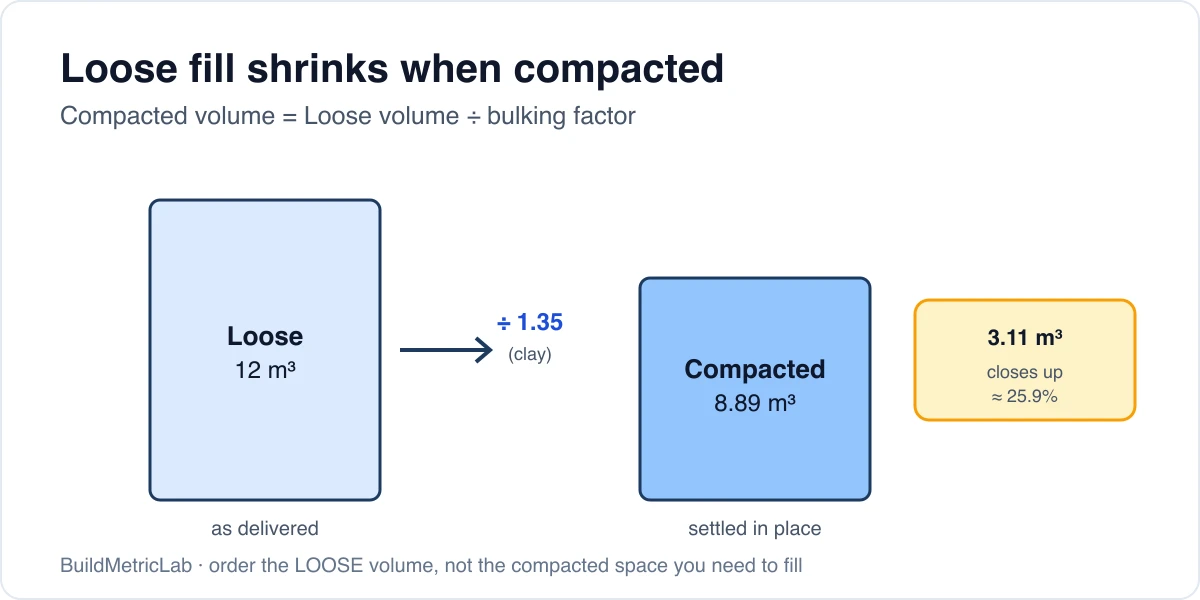
A 12 cubic metre (about 16 cubic yard) load of loose clay does not stay 12 cubic metres once it is laid. After a plate compactor has passed over it, that same fill settles to roughly 8.89 cubic metres in place. The missing 3.11 cubic metres was air, squeezed out of the voids under compaction — a shrinkage of about 26 per cent. That gap is what a compaction factor measures, and it decides whether a backfilled trench finishes level or sinks into a dip that needs a second load. For a homeowner it means a delivery that actually fills the hole; for a groundworker pricing the job it means a quantity that holds up on site.
What is a compaction factor?
A compaction factor describes the relationship between the loose volume a material occupies and the settled volume it takes up once laid and compacted. Loose fill is full of voids. Tipping, spreading and rolling drive those voids out, so the material shrinks into a denser mass. That shift from loose to compacted volume is what the factor puts a number on.
The calculator expresses this as a material bulking factor — the ratio of loose volume to in-situ volume — and divides the loose volume by it to estimate the settled result. A bulking factor of 1.35 for clay means loose clay occupies 1.35 times its compacted volume, so dividing by 1.35 returns the in-situ figure. Materials differ: cohesive soils such as clay hold more air when loose and settle noticeably, while granular materials such as sand interlock and lose less. The factor stays an estimate, because real settlement shifts with moisture, layer depth and compaction effort.
Why it matters for drainage and earthworks work
Earthworks ordering lives or dies on volume accuracy. Order too little and the job stalls while a second load is arranged at a part-load rate; order too much and the surplus has to be moved or skipped, which the skip and dumpster size calculator can help size.
Drainage work sharpens the stakes. Trench backfill needs to compact evenly so the run holds its gradient and the surface does not subside, which makes the settled in-place volume the figure that actually matters. Checking how far a loose delivery settles in the compaction factor calculator before ordering helps the trench finish at the intended level. Your local building regulations and earthworks standards set expectations for ground-bearing and substructure work that depend on properly compacted, quantified fill — in the UK, for example, the NHBC Standards; check your local equivalent.
How the calculation works
The calculation starts from the loose volume you expect to receive and divides it by a material-specific bulking factor to estimate the settled in-situ volume. This loose-to-compacted step is the heart of the tool, and the shrinkage percentage falls straight out of the same factor.
Compacted volume = Loose volume ÷ Bulking factor
Shrinkage %      = ( 1 − 1 ÷ Bulking factor ) × 100
Where:
- Loose volume = the bulk volume of material as delivered or excavated, in cubic metres (cu yd)
- Bulking factor = a material-specific multiplier above 1, reflecting how much the loose material has expanded from its in-situ state
- Compacted volume = the estimated in-place volume after laying and compaction
- Shrinkage = the share of the loose volume that closes up as the voids are driven out
The tool holds trade-default bulking factors by material: clay 1.35, chalk 1.40, loam and topsoil 1.25, sand 1.15, and rock 1.65. A higher factor means more air to drive out and a larger drop from loose to settled volume.
Bulking factors and shrinkage by material
The calculator holds a trade-default bulking factor for each material. A higher factor means more air to drive out, so a larger drop from loose to settled volume.
| Material | Bulking factor | Shrinkage (loose → compacted) | Compacted from 12 m³ loose |
|---|---|---|---|
| Sand | 1.15 | 13.0% | 10.43 m³ |
| Loam / topsoil | 1.25 | 20.0% | 9.60 m³ |
| Clay | 1.35 | 25.9% | 8.89 m³ |
| Chalk | 1.40 | 28.6% | 8.57 m³ |
| Rock | 1.65 | 39.4% | 7.27 m³ |
A worked example with real numbers
Priya is backfilling a drainage trench in her back garden and plans to order loose clay fill. She enters a loose volume of 12 cubic metres and selects clay as the material.
The calculator divides by the clay bulking factor of 1.35 to estimate the settled volume:
Compacted volume = 12 m³ ÷ 1.35 = 8.89 m³Roughly 8.89 cubic metres of compacted clay ends up in the trench; the remaining 3.11 cubic metres closes up as the material densifies, a shrinkage of about 25.9 per cent. The tool reports the same three figures — the in-situ volume, the 1.35× bulking factor, and the shrinkage percentage — so Priya can see at a glance that a 12 cubic metre delivery will not fill a hole that needs 10 cubic metres in place. These figures are estimates that depend on the factor the tool holds for clay; actual settlement varies with moisture and compaction effort. You can reproduce the numbers in the compaction factor calculator.
How to use the compaction factor calculator
The compaction factor calculator takes two inputs. The first is the loose volume in cubic metres, defaulting to 10 in half-metre steps. The second is the material, chosen from a drop-down — clay, loam, sand, chalk, rock or topsoil — which sets the bulking factor behind the scenes.
With the loose volume you expect to receive entered and the matching material selected, the tool returns the settled in-situ volume, the bulking factor it applied, and the shrinkage percentage. It does not price the material or add a wastage margin: it converts loose volume to compacted volume, and the output works as an ordering aid rather than a specification.
Common scenarios
Backfilling a drainage trench
A homeowner running a new soakaway pipe needs the trench backfilled so the surface finishes level once the ground settles. Estimating the loose clay, then checking the settled in-place volume, helps avoid a later dip over the run. Pairing the estimate with a French drain calculator keeps the aggregate and pipe quantities consistent.
Raising a garden level before landscaping
Bringing a sunken lawn up to a new level calls for imported fill compacted in layers. A loose-volume figure read as the finished level overstates what the ground will actually hold, because the fill settles once compacted. The in-situ figure reflects the volume that stays put.
Estimating a small groundworks quote
A tradesperson pricing a modest backfill job needs a defensible material quantity before adding labour and plant. The settled-versus-loose distinction protects the margin, since quoting on loose volume alone risks ordering short. For setting the fall on a backfilled run, the pipe gradient calculator covers the gradient side.
Common mistakes
- Confusing loose and settled volume — material arrives loose and shrinks once compacted, so a hole sized on the loose figure comes up short.
- Applying one factor to every material — clay settles far more than sand (1.35 against 1.15), so a single rule of thumb skews the estimate.
- Treating the trade-default factor as exact — moisture, layer depth and compaction effort all move real settlement, so the default is a starting point rather than a measured result.
- Reading a volume estimate as a specification — the tool sizes the quantity, not the build-up; layer depths and load-bearing details are matters for a qualified groundworker or engineer.
Related calculations and tools
Earthworks jobs rarely involve a single calculation. These BuildMetricLab tools cover the connected steps:
- skip and dumpster size calculator — size the disposal of surplus spoil
- French drain calculator — estimate aggregate and pipe for a drainage run
- pipe gradient calculator — set the fall a backfilled pipe run needs to hold
Sources and methodology
The compaction factor calculator applies trade-default bulking factors by material and divides the loose volume by the matching factor to estimate the settled in-situ volume, reporting the shrinkage that goes with it. The defaults reflect typical practice, not a site-specific test, and the article figures were checked by hand against the calculator output for the same inputs.
General engineering guidance on earthworks and soil behaviour informs the approach:
- Geotechnical earthworks and soil-compaction engineering guidance on bulking and in-situ volume
- An engineering handbook or field guide to excavation swell and shrinkage factors by soil type
- Your local building regulations and geotechnical or earthworks standards — in the UK, for example, the NHBC Standards; check your local equivalent
Results vary with site conditions. For load-bearing, drainage compliance, or specification decisions, consult a qualified civil engineer or groundworker.
The bottom line
Loose and compacted material are not the same volume, and the gap decides whether a delivery fills the space or falls short. The compaction factor calculator divides a loose volume by a material bulking factor to estimate the settled in-situ volume, and reports the shrinkage that goes with it. Used as an ordering aid alongside proper professional specification, it keeps deliveries realistic and surfaces level.
Frequently asked questions
How is a compaction factor different from a bulking factor?
A bulking factor describes how much loose material has expanded from its settled, in-situ state — loose volume divided by in-situ volume. Compaction reverses that expansion, driving the air back out so the material returns toward its in-situ volume, so the two are sides of the same ratio. This calculator works on the laying side: it takes the loose delivered or excavated volume and divides by the material's bulking factor to estimate the compacted in-place volume, then reports the shrinkage. Excavated clay can bulk by around 35 per cent as it loosens, then lose much of that again under a roller or plate compactor. Treating the loose and settled figures as interchangeable is a common source of over- or under-ordering.
Does the compaction factor change with moisture content?
Yes, and on cohesive soils such as clay the effect is significant. Material compacted near its optimum moisture content settles into a denser, more stable mass than the same material laid too dry or saturated. The calculator uses a single trade-default factor for each material, so it estimates a typical result rather than a site-specific one. Ground that is waterlogged, frozen, or baked hard may need a revised allowance. For trench backfill near drainage runs, moisture on the day matters enough that an on-site check by the groundworker helps before the final order goes in.
Can I use the calculator for sub-base under a driveway?
The tool estimates settled volume for a range of fill materials, so it can illustrate quantities for a granular sub-base layer as well as cohesive backfill. The figure it returns is a volume estimate, not a layer-thickness or load-bearing specification. A driveway build-up that carries vehicles depends on the sub-grade, the chosen material, and the compacted depth, none of which the volume calculation decides for you. The number helps with how much to order; the construction detail belongs with a qualified groundworker or engineer.
Does the calculator give a cost or an order quantity?
No. It returns the settled in-situ volume, the material bulking factor it applied, and the shrinkage percentage — and nothing more. It holds no material prices and adds no wastage margin, so for a cost figure pair it with a supplier quote, and add your own wastage allowance to the loose volume before ordering. Keeping the tool to the volume conversion is deliberate: prices move with the market and wastage swings with site conditions, so both belong with figures you supply rather than a baked-in default.