· Timber & Framing
How Many Decking Boards Do I Need
Rows across the deck, running length along it, whole boards to cover that length. The formula, a worked example carried through in metric with imperial equivalents, the gap and wastage allowances that shift the count, and the board sizes that the same question travels under in the UK, North America and Australia.
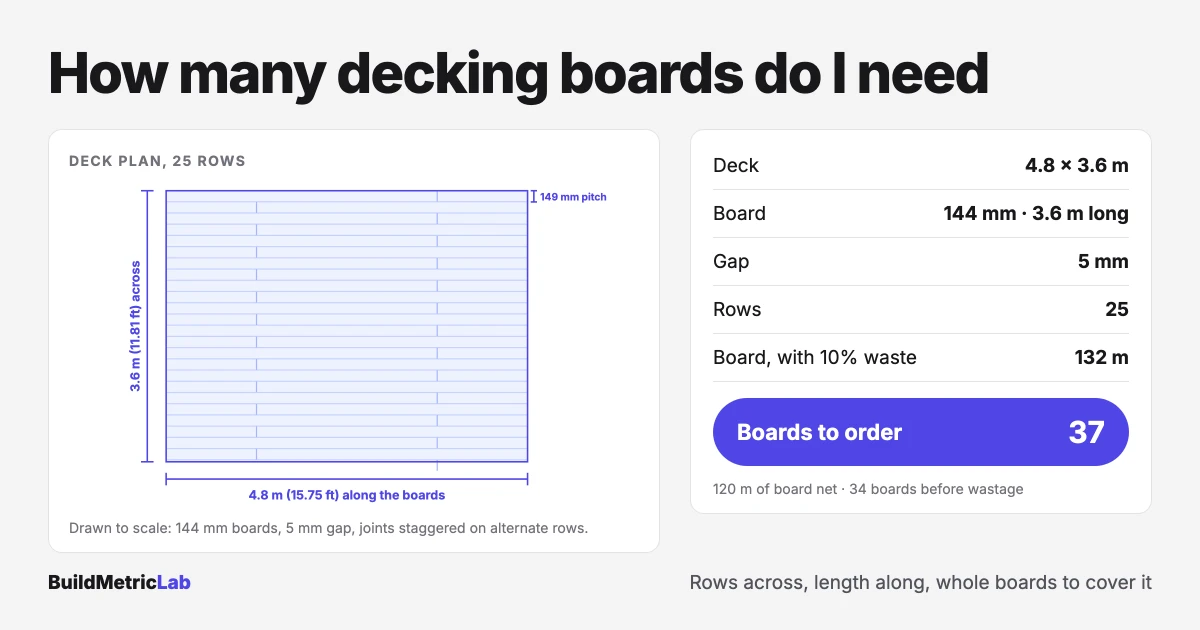
A deck 4.8 m by 3.6 m (15.75 × 11.81 ft) laid in 144 mm (5.67 in) boards with a 5 mm (0.2 in) gap works out at 25 rows, 120 m (394 ft) of board, and 37 boards of 3.6 m (11.81 ft) once cutting waste is allowed for. How many decking boards do I need is the first question a deck asks, and the arithmetic behind the answer is short: rows across the deck, running length along it, whole boards to cover that length. The decking board calculator carries the sum; this post shows the working so the number can be checked before anything is ordered.
What is the number of decking boards?
The number of decking boards is the count of whole boards, at the length a supplier sells them, needed to cover a deck once the gaps between boards and the cutting waste are included. It is a count, not an area. Two decks of identical area can need quite different counts, because one uses wider boards, longer stock lengths or a tighter gap than the other. Four things set the figure: the size of the deck, the width of the board, the gap between boards, and the stock length. The material is called decking in the UK, Ireland, Australia and New Zealand, and deck boards or deck planks in the United States and Canada. Same product, same sum.
Why the number of decking boards matters
Boards are bought by the piece and delivered by the pack. Order short and the last two rows wait for a second delivery, usually from a different batch, with a different colour and a different moisture content that never quite matches. Order long and the surplus is money sitting in the garage. Ten minutes of arithmetic avoids both.
The count also drives everything under and around the surface. Each row of boards needs two fixings at every joist, so the row count sets the screw order. The stock length decides where the joints fall, which in turn decides how the joists are set out. And the total decides how the timber arrives: 37 boards of 144 × 28 mm (5.67 × 1.10 in) is roughly 0.54 m³ (19 cu ft) and around 270 kg (595 lb), which is a pallet and a kerbside drop, not a car boot (trunk).
How many decking boards do I need? The formula
Decking boards run at right angles to the joists beneath them. For the sum, the deck's width is the dimension measured across the boards and the length is the dimension along them. Get those two the right way round and the rest follows.
First, count the rows. Every row occupies its own board width plus one gap, so the deck width divided by that pitch gives the number of rows, rounded up, because a part row still needs a board. Second, multiply the rows by the deck length to get the running length of board. Third, add a wastage allowance for cuts, split ends and the odd bowed board. Fourth, divide by the stock length and round up to whole boards.
Rows:            R  = ceil( W / ((b + g) / 1000) )
Running length:  Lr = R x L
With wastage:    Lw = Lr x (1 + waste)
Boards to order: N  = ceil( Lw / Lb )

Board per m2:    Lr / (W x L)  =  1 / ((b + g) / 1000)
Where:
- W = deck width measured across the boards, m (ft)
- L = deck length measured along the boards, m (ft)
- b = board width, mm (in)
- g = gap between boards, mm (in)
- R = number of rows, dimensionless
- Lr, Lw = running length of board, net and with wastage, m (ft)
- waste = wastage allowance, dimensionless (0.10 for 10%)
- Lb = stock length of one board, m (ft)
- N = whole boards to order, dimensionless
A worked example
Take a deck 4.8 m (15.75 ft) along the boards and 3.6 m (11.81 ft) across them, an area of 17.28 m² (186 sq ft). The boards are 144 × 28 mm (5.67 × 1.10 in) softwood sold in 3.6 m (11.81 ft) lengths, laid with a 5 mm (0.2 in) gap. Wastage is 10%.
Step 1, rows. The pitch is 144 + 5 = 149 mm (5.87 in). 3,600 ÷ 149 = 24.16, which rounds up to 25 rows.
That fraction deserves a second look before anything is cut. Not because the maths is wrong. Twenty-five rows at 149 mm pitch cover 25 × 144 + 24 × 5 = 3,720 mm (12.2 ft), which is 120 mm (4.7 in) more than the frame. Laid as calculated, the last board gets ripped down to a 24 mm (0.9 in) sliver. There are two tidy ways out. Widen the gap: 24 full boards cover 3,456 mm, and spreading the remaining 144 mm across 23 gaps gives 6.3 mm (0.25 in). Nobody will notice. Or set the frame out at 3,720 mm so 25 whole boards fit at 5 mm. The calculator rounds up because rounding down leaves bare joist; the setting-out decision stays with you.
Step 2, running length. 25 × 4.8 = 120 m (393.7 ft).
Step 3, wastage. 120 × 1.10 = 132 m (433 ft).
Step 4, boards. 132 ÷ 3.6 = 36.67, which rounds up to 37 boards.
The cutting plan explains where the waste goes. Each 4.8 m row is one full 3.6 m board plus a 1.2 m (3.94 ft) piece, and three of those pieces come out of a single board with no offcut at all. So 25 rows take 25 full boards plus 25 × 1.2 = 30 m of short pieces: 8.33 boards, so nine. That is 34 boards net, exactly what the calculator returns with wastage set to zero. The 10% allowance lifts it to 37: three spare boards for a split end, a bowed length, or a cut that goes wrong. Stagger the joints so they land on different joists row by row.
Rounding early is the trap. Round the pitch to 150 mm and 3,600 ÷ 150 = 24 exactly, so a row disappears from the count. Laid at the real 149 mm pitch, 24 rows cover only 3,571 mm and leave a 29 mm (1.1 in) strip of joist showing along one edge.
Weight and fixings. One board is 0.144 × 0.028 × 3.6 = 0.0145 m³ (0.51 cu ft). Thirty-seven of them come to 0.537 m³ (19 cu ft), and at about 500 kg/m³ (31 lb/cu ft) for dry softwood that is roughly 270 kg (595 lb). Freshly pressure-treated stock (tanalised, in UK trade language) arrives wetter and heavier. With joists at 400 mm (15.75 in) centres there are 13 joists under the 4.8 m run, and two screws per board per joist gives 25 × 13 × 2 = 650 screws, plus a handful more wherever two board ends meet on one joist.
How to use the decking board calculator
The decking board calculator takes the deck length and width in metres, the board width and gap in millimetres, the stock length in metres, a wastage percentage and an optional price per board. Width is the dimension across the boards, so if the boards will run the other way, swap the two deck figures. The gap is the one you will actually lay to, which depends on the material: a typical figure for timber is 5 to 6 mm, and composite makers publish their own.
The result panel leads with the number of boards to order. Beneath it sit the deck area, the row count, the running length with wastage already included, and an estimated cost if a price has been entered. There is no unit toggle on the page. The UK, Canadian and Australian versions take metres and millimetres and report square metres, and the worked example above comes back from them as 17.28 m², 25 rows, 132 m and 37 boards. The US version takes feet and inches, opens on 5/4 × 6 boards at a 1/4 in gap, and reports square feet: its own default 16 × 12 ft (4.88 × 3.66 m) deck in 12 ft boards returns 26 rows and 39 boards. The tool links in this post open the version for your region where one exists, and the region switcher in the site header moves between the four sites. The price field takes whatever local currency and rate apply, before any local sales tax or VAT.
The row count is worth carrying to the next step. The joists, ledger, posts and noggins (blocking in North America, dwangs in New Zealand) come from the deck framing calculator.
Common scenarios
A UK garden deck in grooved softwood
The calculator's defaults describe this one: 5 × 3 m (16.4 × 9.84 ft), 144 mm boards, 5 mm gap, 3.6 m lengths, 10% wastage. Rows: 3,000 ÷ 149 = 20.1, so 21. Running length 105 m (344 ft), 116 m (379 ft) with waste, and 33 boards. The grooved face (reeded, in some catalogues) is a UK and Irish habit; the count is the same whichever side faces up.
A North American deck in 5/4 × 6 boards
Nominal 5/4 × 6 decking dresses to 1 × 5.5 in, which is 25 × 140 mm. On the 4.8 × 3.6 m deck with a 5 mm (3/16 in) gap the pitch is 145 mm, so 3,600 ÷ 145 = 24.8 and again 25 rows. Sixteen-foot (4.88 m) stock is common, so entering 4.8 m makes each row a single board: 120 m net, 132 m with waste, and 132 ÷ 4.8 = 27.5, so 28 boards. Use the dressed width, never the nominal one, or the count comes out two rows short.
An Australian deck in 90 mm boards
Australia and New Zealand favour narrower boards, typically 90 × 22 mm (3.54 × 0.87 in) in treated pine or a hardwood such as merbau, laid at a 4 mm (0.16 in) gap. The pitch drops to 94 mm and the same 3.6 m width needs 3,600 ÷ 94 = 38.3, so 39 rows. In 4.8 m lengths that is 187.2 m (614 ft) net, 206 m (676 ft) with waste, and 43 boards. Narrow boards also mean far more fixings: 39 rows over 13 joists is over a thousand screws.
Composite decking
Composite boards are generally 140 to 146 mm wide and sold in 3.6 or 4.8 m lengths, so the sum is identical. What changes is the gap, which the manufacturer specifies for thermal movement rather than shrinkage, and which often differs side to side versus end to end. Enter the maker's side gap as the gap figure, and allow the end gaps in the cutting plan rather than the count.
Boards laid diagonally
A 45-degree layout cuts every board at an angle at both ends, and the offcuts rarely match the next row. Wastage of 15% rather than 10% is the usual starting point, and a picture-frame border, if there is one, is counted as its own run around the perimeter.
Common mistakes
- Measuring width along the boards instead of across them. Swap the two on a 4.8 × 3.6 m deck and the calculator returns 33 rows of 3.6 m instead of 25 rows of 4.8 m. Same area, different cutting plan.
- Using the nominal width. A board sold as 6 in is 5.5 in wide once dressed, and 152 mm in the formula instead of 140 mm turns 25 rows into 23. Measure a board or use the dressed size from the data sheet.
- Forgetting the gap, or using the wrong one. The gap is part of the pitch, and it also depends on the timber. Kiln-dried and composite boards are fixed at the specified gap. Freshly treated softwood shrinks as it dries, so it is often fixed tighter, on the understanding that the gap will open to its final width rather than past it. A 10 mm gap a year on is a common sight, and it usually starts here.
- Ordering by area. A coverage figure knows nothing about stock lengths, so the offcuts never add up to whole boards.
- Leaving out wastage, or applying it twice. Ten per cent suits a plain rectangle; diagonal or multi-level decks take more. The calculator applies the allowance to the running length before dividing by the stock length, so there is no need to add it to the count as well.
- Mixing metric and imperial mid-sum. A width in feet against a pitch in millimetres will not reconcile. Convert once, at the start, and stay in one system to the final figure. The US calculator page works in feet and inches throughout and the other three in metres and millimetres, which is the simplest way to avoid it.
Sources and methodology
The method is geometry. Rows come from the board pitch, running length from the rows, and boards from the running length, all of which is reproducible from the formulas above. Every figure in the worked example and the scenarios was run through the same handler the calculator uses, with a 10% wastage allowance applied to the running length before rounding up to whole boards. A method that rounds the count up first and then adds wastage can land one board higher. That is the margin to expect when reconciling against a supplier's own estimate.
The reason a gap exists at all is moisture movement, and the standard reference for how much timber shrinks and swells across the grain is the Forest Products Laboratory's Wood Handbook, published in the United States but used a long way beyond it. The structure beneath the boards is a design matter: Eurocode 5 (EN 1995-1-1) is the European example of a timber design code, and the deck framing behind it is the subject of national guides such as the American Wood Council's prescriptive deck guide in the United States and the Timber Decking and Cladding Association's code of practice in the UK. Check the equivalent for your own region, and treat the board width printed on the supplier's data sheet as the governing figure for any count.
- Forest Products Laboratory: Wood Handbook, wood as an engineering material (FPL-GTR-282)
- European Commission Joint Research Centre: Eurocode 5, design of timber structures
Putting it together
Rows across, length along, whole boards to cover the length: that is the entire method, and it holds whether the boards are 144 mm softwood in a UK garden, 5/4 × 6 in cedar in Ontario, or 90 mm merbau in Queensland. The judgement sits around the edges of the sum. Which way the boards run, whether the dressed width matches the catalogue, what gap the material actually wants, and whether the last row fits or needs the gaps nudged. Settle those, run the decking board calculator for the count, and carry the row figure through to the frame. For the whole-project picture, boards, frame, fixings, footings and labour together, the patio and deck cost calculator takes the same dimensions and your own local rates.
Frequently asked questions
How many decking boards do I need for a 4 m by 3 m deck?
Run the boards along the 4 m side and the 3 m dimension is the one measured across them. With 144 mm boards at a 5 mm gap the pitch is 149 mm, so 3,000 divided by 149 is 20.1, which rounds up to 21 rows. Twenty-one rows of 4 m is 84 m of board (276 ft), and 10% wastage takes that to 92.4 m (303 ft). In 3.6 m lengths that is 25.7, so 26 boards; in 4.8 m lengths it is 19.3, so 20. Rounding up matters at each stage: a part row still needs a board, and a part board still has to be bought whole. If the boards run the other way, swap the two deck dimensions before starting.
How many decking boards do I need per square metre?
Divide one metre by the board pitch in metres, where the pitch is the board width plus the gap. For 144 mm boards at a 5 mm gap that is 1 divided by 0.149, or about 6.7 linear metres of board per square metre before waste (roughly 2.05 ft of board per square foot). At 140 mm and 5 mm it is 6.9 m; at 90 mm and 4 mm, narrow boards in the Australian style, it rises to 10.6 m. Multiply by the deck area for the running length, add 5 to 10% for cutting, then divide by the stock length and round up. Coverage figures are a useful sanity check, but the row-by-row method is the one to order from, because it handles the part row at the edge.
What gap should I leave between decking boards?
It depends on the material and its moisture content when it is fixed. Kiln-dried softwood and hardwood are typically laid at 5 to 6 mm (about 1/4 in), which lets water drain and leaves room for the boards to swell in wet weather. Freshly pressure-treated softwood arrives wet and shrinks as it dries, so installers often fix it tighter, at 3 to 4 mm, expecting the gap to open. Composite boards move with temperature rather than moisture, and each manufacturer publishes its own side and end gaps, which are the figures to enter. Whatever the gap, it is part of the pitch, so a change from 3 mm to 6 mm on a 3.6 m wide deck can shift the row count by one.
Do I need to add wastage to a decking board order?
Yes, as a rule of thumb between 5 and 10% for a plain rectangular deck and around 15% for boards laid diagonally or around obstacles. The allowance covers cut-offs that are too short to reuse, boards that arrive split, bowed or with a dead knot at the edge, and the occasional cut that goes wrong. On a deck where the stock length divides neatly into the row length, as with 3.6 m boards on a 4.8 m run, the geometric waste is very small and most of the allowance goes to defects. Apply the percentage once, to the running length or the count but not both. Three spare boards on a 34-board order is typical, and they are far cheaper than a second delivery from a different batch.
How many boards are in a 12 by 12 foot deck?
A 12 by 12 ft deck is 3.66 m square, about 13.4 m² (144 sq ft). In North American 5/4 × 6 boards, which dress to 5.5 in (140 mm) wide, at a 3/16 in (5 mm) gap the pitch is 5.69 in (144.5 mm), so 144 inches divided by 5.69 is 25.3, which rounds up to 26 rows. Each row is one 12 ft board, so 26 boards net and about 29 with 10% wastage. In 144 mm boards at a 5 mm gap the count is 24.6 rows, so 25, and 25 boards of 3.66 m with three or so spare. The 12 ft stock length is what makes this deck simple: no joints along a row, so the geometric waste is close to nil and the allowance is there for defects.