· Bathroom
Bathroom Tile Calculator: How Many Tiles?
A bathroom tile calculator converts floor area, tile size, wastage and unit price into a tile count and a rough materials cost. This guide shows the formula, a fully worked UK example, and the estimating mistakes that lead to a second trip to the merchant.
A standard 12m² bathroom floor tiled in 300mm by 300mm porcelain works out at roughly 133 bare tiles, yet the order that actually leaves the merchant is closer to 147 once a tiling allowance is added. That gap of fourteen tiles is the difference between finishing the job on a Saturday and making a Monday trip back for a box that might no longer be in the same batch. Getting the count right before the order goes in is the quiet part of a tidy bathroom refit.
This guide explains how a tile estimate is built from a handful of numbers, walks through a full worked example for a typical UK bathroom, and sets out the mistakes that send people back to the trade counter. The bathroom tile calculator does the arithmetic in seconds, but understanding what sits underneath the figure is what stops a small rounding habit turning into a shortfall.
What is a bathroom tile calculator?
A bathroom tile calculator is an estimating tool that converts a floor area and a tile size into the number of tiles needed, then adds a wastage allowance and an illustrative cost. It removes the mental arithmetic of dividing room area by tile area and rounding sensibly for cuts.
The version on BuildMetricLab takes five inputs: floor area in square metres, tile width and length in millimetres, a wastage percentage, and a price per tile. From those it estimates a tile count and a rough materials figure. It is built for two readers at once. A homeowner planning a refit uses it to sanity-check a quote or budget; a tradesperson uses it to turn a quick site measure into an orderable quantity before phoning the merchant.
Why it matters for bathroom work
Bathrooms are small rooms with a high density of cuts. Soil pipes, basin pedestals, shower trays and door thresholds all interrupt the tile field, so the proportion of tiles that end up cut is higher than in an open floor like a kitchen or hallway. That raises the practical wastage compared with a simple area sum.
Cost movement makes the count worth pinning down too. The ONS construction output price indices track how material and labour prices shift across the sector, and tiling materials have not been immune to the broader rises of recent years. An estimate built on current per-tile pricing is more useful than a figure carried over from an older job.
There is also a moisture dimension that sits behind tile choice. Building Regulations Approved Document C deals with resistance to moisture in floors and walls, and bathroom substrates frequently need tanking or a suitable backing board before tiling. The calculator estimates quantities only; the specification of substrate, waterproofing and any structural matter belongs with a qualified tiler or building professional.
How the calculation works
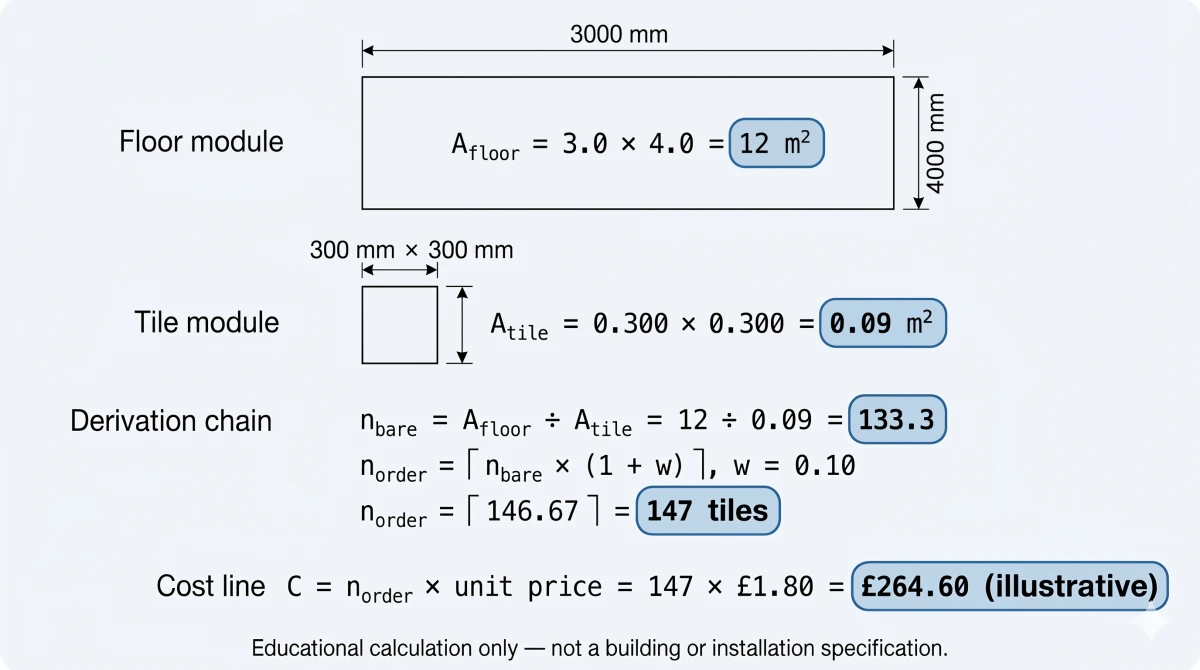
The core method is area divided by area. The room floor area is divided by the area of a single tile to give a bare count, then a wastage multiplier is applied, and the result is rounded up to the next whole tile because tiles are sold as units.
In plain notation the calculation looks like this:
tile area (m²)  = (width_mm ÷ 1000) × (length_mm ÷ 1000)
bare tiles       = floor_area_m² ÷ tile area
tiles needed     = round_up( bare tiles × (1 + wastage ÷ 100) )
estimated cost   = tiles needed × price_per_tile
Where:
- floor_area_m² = the tiled floor area, measured in square metres
- width_mm and length_mm = the tile face dimensions in millimetres, converted to metres before multiplying
- wastage = a percentage uplift covering cuts, breakages and unusable offcuts
- price_per_tile = the unit price used for the illustrative cost line
Two details matter. Tile dimensions are entered in millimetres because that is how tiles are sold, so the formula divides by 1000 to reach metres. And the rounding happens once, at the very end, after wastage is applied, which keeps the allowance honest rather than rounding a figure and then padding it a second time.
A worked example with real numbers
Priya is refitting the family bathroom in a 1990s semi. The floor measures 3m by 4m, giving a tiled area of 12m². She has chosen a 300mm by 300mm matt porcelain floor tile priced at £1.80 each, and she is using a 10% wastage allowance for a room with a WC, a basin pedestal and a bath panel to cut around.
Step one is the tile area. A 300mm tile is 0.300m on each side, so its face area is 0.300 × 0.300 = 0.09m².
Step two is the bare count. The floor area divided by the tile area is 12 ÷ 0.09 = 133.33 tiles. That is the theoretical figure with no cuts wasted.
Step three applies wastage. Adding 10% gives 133.33 × 1.10 = 146.67 tiles. Rounding up to the next whole tile lands on 147 tiles.
Step four is the illustrative cost: 147 × £1.80 = £264.60 for the floor tiles alone, before adhesive, grout, trim and labour.
Running the same inputs through the bathroom tile calculator returns the same 147 tiles and £264.60, which illustrates the method rather than promising a final invoice. Adhesive, grout and any wall tiling are separate lines, and a full project budget can be framed with the bathroom renovation cost calculator.
How to use the bathroom tile calculator
The tool is built around the five inputs already described, each with a sensible default so a first estimate appears immediately. Floor area defaults to 12m², tile dimensions to 300mm by 300mm, wastage to 10% and price to £1.80, which together describe a fairly typical small UK bathroom floor.
To estimate a real job, measure the floor and enter the area in square metres, then set the tile width and length in millimetres to match the product being priced. Adjust the wastage to reflect how cut-heavy the room is, and replace the unit price with the figure from a supplier quote so the cost line means something. The methodology uses UK trade defaults, and the prices are illustrative rather than live merchant pricing.
For a quick re-estimate when comparing tile formats, change only the width and length and watch the count move. The bathroom tile calculator recalculates instantly, which makes it easy to see how a switch from 300mm to 600mm tiles changes both the count and the cut pattern.
Common scenarios
Small cloakroom with large-format tiles
A downstairs cloakroom might have only 2m² of floor. With 600mm by 600mm tiles at 0.36m² each, the bare count is just 5.6 tiles. Applying 10% wastage gives 6.1, which rounds up to 7 tiles, so the allowance does change the order here. In tiny rooms the cut pattern matters more than the percentage, because a single awkward cut around the WC can consume a whole large tile. Estimating with the actual tile size avoids the trap of assuming small rooms need proportionally fewer tiles.
Family bathroom with a feature wall
A 12m² floor plus a tiled feature wall doubles the estimating work, because walls and floor are calculated separately and often use different tile sizes. The floor figure from the worked example stands, while the wall area is measured and run through the same area-divided-by-area logic. Ordering both together from one batch reduces the risk of a shade mismatch on a wall that sits in full view.
Tradesperson pricing several bathrooms in a development
On a small development, a tiler estimating five identical bathrooms multiplies a single per-room figure by five, then reviews the total wastage. Buying in bulk can justify a slightly lower wastage percentage per room, because offcuts from one bathroom sometimes serve as cuts in the next. A consolidated order also keeps every room within the same batch, which a piecemeal approach cannot promise.
Common mistakes
- Measuring in the wrong units — entering tile dimensions in centimetres or the floor in square feet skews the count badly. The calculator expects millimetres for tiles and square metres for floor area, matching how UK suppliers list products.
- Setting wastage too low for a cut-heavy room — a default 10% suits a simple rectangle, but a room full of fixtures, alcoves or a diagonal lay pattern often needs more. Results vary by site conditions, and a tiler can judge the right allowance on inspection.
- Forgetting that walls and floor are separate — the floor estimate does not include wall tiles. Each surface is measured and estimated on its own, then the quantities are combined for ordering.
- Treating the cost line as a final price — the figure covers tiles only. Adhesive, grout, trim, waterproofing and labour all sit outside it, which is why a full budget tool gives a more complete picture.
- Ordering exactly the estimated count with no spares — keeping a few tiles back for future repairs is sensible, since a later top-up may come from a different batch with a slightly different shade.
Related calculations and tools
A bathroom refit rarely stops at the floor, and a few neighbouring calculators help frame the wider job:
- Bathroom renovation cost calculator — build a fuller budget across labour and materials, not just tiles
- WC clearance checker — sanity-check the space around the toilet before the layout is fixed
- Towel rail BTU calculator — size the heated towel rail for the room
Frequently asked questions
How accurate is a tile estimate for a non-rectangular bathroom?
For an L-shaped or irregular room, the estimate is only as good as the floor area fed into it. Splitting the floor into rectangles, calculating each area, and summing them gives a reliable total to enter. The tile count itself stays accurate once the area is right, but irregular rooms usually carry more cuts, so a slightly higher wastage percentage reflects reality better. The method illustrates a quantity rather than guaranteeing it, and a tiler measuring on site will refine both the area and the allowance for a firm order.
Can I use the calculator for wall tiles as well as floor tiles?
The same area-divided-by-area logic applies to walls, but the input here is floor area, so walls are estimated as a separate calculation. Measure the tiled wall area in square metres, then enter that figure with the wall tile dimensions to get a wall count. Doors, windows and the area behind a bath can be deducted or left in as a built-in allowance, depending on how cautious the estimate needs to be. Keeping floor and wall figures distinct makes ordering and batching clearer.
How do I convert square feet to square metres for the area input?
Older plans and some merchants still quote in square feet, so a conversion is sometimes needed. One square metre is about 10.76 square feet, so dividing a square-foot figure by 10.76 gives square metres. A 130 square foot floor is therefore roughly 12.1m². Entering the metric figure keeps the calculation consistent with how UK tiles are sized and sold. Rounding the converted area up very slightly is harmless, since the wastage allowance absorbs minor measuring variation anyway.
Does a diagonal or herringbone lay pattern change the count?
The bare tile count stays the same because the floor area and tile area are unchanged, but the practical wastage rises noticeably. Diagonal and herringbone patterns create more edge cuts, and many of those offcuts cannot be reused, so an allowance well above the standard 10% is common for these layouts. The estimate handles this through the wastage input rather than the tile size. A tiler experienced in pattern work can advise on a realistic percentage for the specific design before the order is placed.
Sources and methodology
The calculation uses standard tiling arithmetic: floor area divided by single-tile area, uplifted by a wastage percentage and rounded up to whole tiles. Tile dimensions are handled in millimetres and converted to metres, matching UK product sizing. The figures here illustrate the method and are based on the inputs shown rather than any live supplier quote.
Context for material costs draws on the ONS construction output price indices, which track price movement across the construction sector. Guidance on moisture resistance in bathroom floors and walls sits within Building Regulations Approved Document C. Neither source sets tile quantities; they frame the cost and substrate context around an estimate. For specification of waterproofing, substrate or any structural matter, a qualified tiler or building professional is the right point of reference.
The bottom line
A tile estimate is simple arithmetic done carefully: get the floor area and tile size right, apply a wastage allowance that matches how cut-heavy the room is, and round up to whole tiles before ordering. The worked example shows a 12m² floor in 300mm tiles landing at 147 tiles and roughly £264.60, a figure to confirm against a supplier quote rather than treat as a final invoice. Running the numbers through the bathroom tile calculator before the order goes in is the easiest way to avoid that second trip to the merchant.