· Bathroom
Bath Volume Calculator: How Many Litres Does a Bath Hold?
Working out how many litres a bath holds matters for hot water sizing, heating costs and waste pipe specification. A bath volume calculator turns three measurements into a usable figure in seconds, and this guide shows the maths behind it.
A standard 1700 by 750 mm UK bath filled to a sensible level holds roughly 357 litres of water. That is over a third of a tonne sitting on the floor, drawn from a hot water cylinder that may only store 150 litres, and heading into a 40 mm waste pipe when the plug is pulled. Every one of those numbers depends on the same starting figure: the actual volume of the tub.
This guide explains how the calculator turns three measurements into a litre figure, why the fill factor matters, and how trades use the result to plan cylinder size, heating cost and waste discharge. The worked example below produces a result that can be verified against the bath volume calculator directly.
What a bath volume calculation actually measures
Bath volume is the quantity of water a bath holds at a given fill level, expressed in litres for UK plumbing work or gallons for older specifications. The figure is not the manufacturer's capacity rating, which usually assumes the tub is filled to the overflow with no person in it. Real-world volume sits well below that line.
A bath volume calculator approximates the tub as a rectangular box: internal length times internal width times fill depth. The result is then reduced by a fill factor that accounts for the curved base, sloped headrest, and the fact that nobody fills a bath to the rim. For straight-sided acrylic baths, the approximation is accurate to within roughly 5 per cent.
The output matters because litres translate directly into kilograms. A 357-litre bath holds 357 kg of water before anyone steps in.
Why bath volume matters for bathroom work
For homeowners, the headline figure is energy cost. Space heating and hot water together account for roughly 80 per cent of UK domestic energy use, with water heating alone making up a meaningful share of that total, according to recent figures from the Department for Energy Security and Net Zero. Heating a 357-litre bath from 10 degrees mains temperature to 40 degrees bathing temperature requires roughly 12.5 kWh at the cylinder, before standing losses.
For tradespeople, the volume figure informs three separate planning conversations. Hot water cylinder sizing assumes the bath plus a basin or shower draw, so a 220-litre hot-water draw against a 150-litre unvented cylinder leaves no headroom. Bathroom point loads matter when planning a refurbishment because a full cast iron bath plus water plus bather can exceed 500 kg, which is a conversation to have with a structural engineer rather than the calculator. Waste discharge calculations under BS EN 12056 depend on the volume emptying through the trap and downstream pipework.
How the calculation works
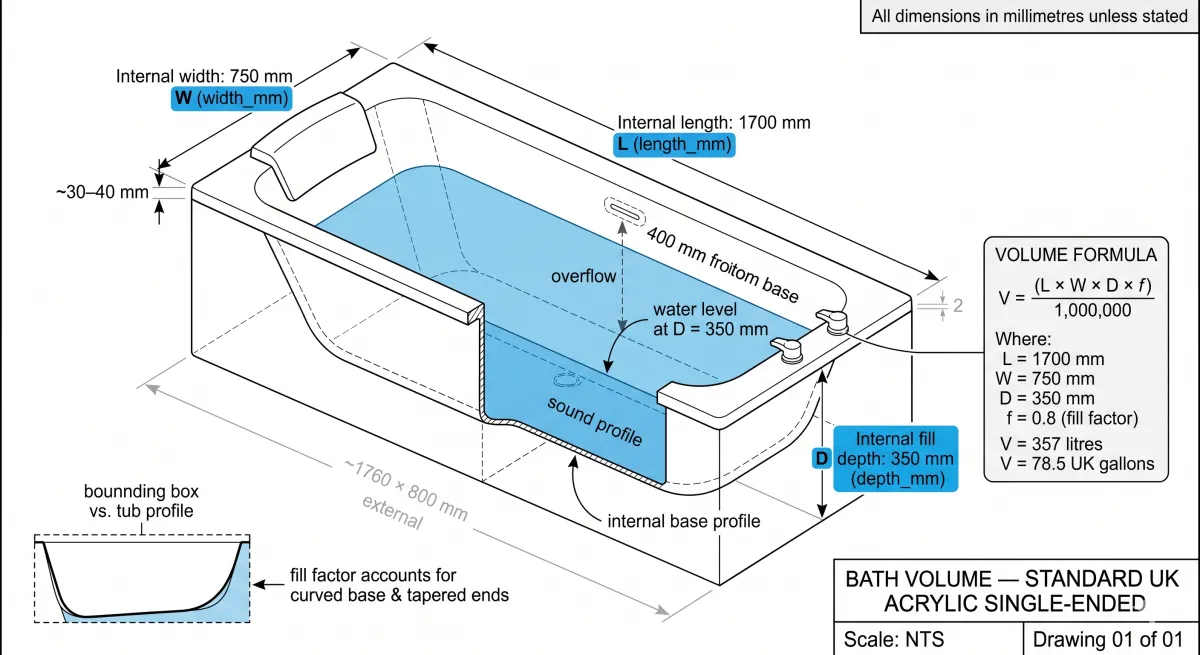
The calculator treats the bath as a box, then trims the result with a fill factor. Inputs are in millimetres because that is how UK bath specifications are published. Output is in litres, since one litre equals one million cubic millimetres.
volume_litres = (length_mm × width_mm × depth_mm × fill_factor) / 1,000,000Where:
- length_mm = internal length of the bath at the rim, measured along the longest axis
- width_mm = internal width of the bath at the rim, measured at the widest point
- depth_mm = intended fill depth from the inside of the base to the water surface, not to the rim
- fill_factor = a dimensionless multiplier between 0.5 and 1.0 that reduces the rectangular volume to account for tub shape and realistic fill height
The default 0.8 fill factor reflects a typical UK acrylic bath filled comfortably below the overflow, with a moderately curved base and standard tapered ends. A slipper bath or roll-top often warrants 0.7. A near-rectangular soaking tub may justify 0.9. The choice has a direct effect: shifting from 0.8 to 0.7 on a 446-litre rectangular volume removes roughly 45 litres from the result.
For older specifications, 1 UK gallon equals 4.546 litres, so 357 litres converts to roughly 78.5 UK gallons.
A worked example with real numbers
A homeowner is replacing a bath in a 1970s semi. The chosen replacement is a standard UK acrylic single-ended model with these measured internal dimensions:
- Internal length: 1700 mm
- Internal width: 750 mm
- Intended fill depth: 350 mm (a typical comfortable bathing depth, well below the overflow at 400 mm)
- Fill factor: 0.8 (standard acrylic bath with mild base curvature)
Step one is the rectangular volume:
1700 × 750 × 350 = 446,250,000 mm³Step two converts to litres by dividing by 1,000,000:
446,250,000 / 1,000,000 = 446.25 litresStep three applies the fill factor:
446.25 × 0.8 = 357 litresPlugging the same four inputs into the bath volume calculator returns 357 litres, which converts to roughly 78.5 UK gallons. The homeowner now has a defensible figure for the cylinder size discussion, the waste pipe conversation, and the heating cost estimate. They can sanity-check the figure against their water meter at the next reading.
How to use the bath volume calculator
The bath volume calculator takes four inputs and returns volume in both litres and UK gallons. Measurements should be taken in millimetres from the inside surfaces of the tub, not from external box or brochure dimensions. External and internal dimensions can differ by 30 to 50 mm on each side because of rim and wall thickness.
Internal length runs along the longest axis between the two inner end walls. Internal width is measured at the widest point of the cavity. Fill depth is the distance from the inside of the base to the water surface, not the full internal height. The fill factor defaults to 0.8 and should be reduced for steeply curved or slipper tubs.
Common scenarios
Planning a hot water cylinder for a new bathroom
A homeowner replacing a vented cylinder in a three-bedroom house wants the new unit to serve the bath plus a basin draw without running cold. A 1700 by 750 mm acrylic bath filled to 350 mm at fill factor 0.8 is 357 litres of fill, of which roughly 220 litres is hot water mixed with cold to reach 40 degrees. A 210-litre unvented cylinder leaves almost no margin for a basin or shower draw immediately afterwards, which is the basis for the conversation about stepping up to 250 or 300 litres with a qualified plumber.
Estimating energy use for a homeowner
Heating 357 litres from 10 degrees to 40 degrees requires the specific heat capacity of water multiplied by the temperature rise, converted to kWh. The result is roughly 12.5 kWh per fill before standing losses. Under the Q2 2026 Ofgem price cap, that gives a per-bath cost the homeowner can multiply by bathing frequency to estimate annual heating outlay attributable to baths.
Planning a waste run for a refurbishment
A 357-litre bath emptying through a 40 mm trap to a 50 mm waste takes several minutes to discharge fully. The volume figure feeds into the BS EN 12056 calculation for discharge units and supports the conversation about upsizing waste pipework, particularly where the run shares with a basin or shower. The pipe length calculator can scope the run distance for material take-off.
Common mistakes to avoid
- Using external dimensions instead of internal — the box may say 1700 mm long, but the inside cavity is closer to 1620 mm once rim and wall thickness are removed. Measure inside the tub.
- Setting fill depth to the rim height — nobody fills a bath to the rim. Use the intended bathing depth, typically 300 to 380 mm.
- Leaving the fill factor at 0.8 for a slipper or roll-top bath — steeply curved internal profiles displace more volume than the rectangular approximation suggests. Drop to 0.7 or measure water displacement directly.
- Forgetting the bather displaces water — an adult bather displaces 70 to 80 litres, which is why baths are filled below the overflow. The calculator output is water volume before the bather gets in.
- Treating the result as a manufacturer specification — the calculator produces an estimate from dimensions and a fill factor. For warranty or compliance work, defer to the manufacturer's published capacity.
Related calculations and tools
Calculations that typically follow a bath volume figure include shower tray sizing, wet-area floor falls, and heat output for the towel rail and pipework.
- Shower tray size calculator — matches tray dimensions to the available bathroom footprint when replacing a bath with a walk-in shower
- Wet room falls calculator — works out the floor gradient needed to drain a wet room properly
- Towel rail BTU calculator — sizes the heat output needed to warm the bathroom and dry towels
- Pipe insulation calculator — estimates the lagging needed for hot supply runs to the bath and basin
For the volume figure itself, the bath volume calculator remains the starting point.
Frequently asked questions
How accurate is a bath volume calculator for a curved or slipper bath?
A rectangular calculation with the standard 0.8 fill factor sits within roughly 5 per cent of the true volume for most acrylic UK baths with mild base curvature. For slipper baths, roll-tops, or steeply contoured designs, the rectangular approximation overestimates volume because it assumes straight walls. Reducing the fill factor to 0.7 brings the estimate closer for these shapes. For absolute precision, measuring water displacement directly by filling through a metered tap gives an exact figure. For estimating and planning, the calculator output is sufficient.
Does bath volume include the bather or not?
The litres figure produced by the calculator is the water volume in the empty bath at the chosen fill depth, before any bather enters the tub. An adult bather displaces roughly 70 to 80 litres of water depending on body mass, which is why the fill level rises noticeably when someone gets in. This is the reason baths are conventionally filled to around 350 mm rather than to the overflow at 400 mm. For hot water sizing calculations, the empty-bath volume is the correct input because that is the volume drawn from the cylinder.
How long does it take to empty a 350 litre bath through the standard waste?
A 40 mm bath waste with a typical trap and a short discharge run to a 50 mm waste pipe drains a 350-litre bath in roughly four to seven minutes, depending on water level, trap design, and the length and falls of the downstream pipework. Blockages, restrictive traps, or shared waste runs serving multiple fixtures lengthen the discharge time noticeably. For refurbishments where existing waste runs are being reused, observing the empty time of the existing bath gives a useful baseline before any changes are designed.
Why does the calculator default to 0.8 for fill factor?
The 0.8 default reflects the typical UK acrylic bath used in domestic installations, which has mild base curvature, tapered ends around the taps and headrest, and a realistic fill depth sitting well below the overflow. Empirical comparison between rectangular calculations at 0.8 and measured water volumes in standard acrylic baths produces results within a few per cent of each other. The default exists so the calculator returns a useful figure straight away for the most common bath type, while remaining adjustable for less standard shapes.
Is the calculator suitable for commercial or care-setting baths?
The same rectangular approximation works for assisted baths, walk-in baths, and care-setting tubs, but the fill factor often needs adjustment because these baths frequently have steeper sides, integral seats, or door cavities that change the effective volume. For care settings, water temperature limits under HSE guidance and infection-control fill protocols may also constrain realistic fill depth. The calculator gives a starting estimate for planning, but specifications for care-setting installations should come from the manufacturer's documented capacity and the relevant care-home design guidance.
Sources and methodology
The formula is the standard geometric volume of a rectangular prism reduced by an empirical fill factor. Weight conversions assume fresh water, where one litre weighs approximately one kilogram. Energy figures use the specific heat capacity of water (4.186 kJ per kilogram per kelvin).
References consulted:
- Approved Documents to the Building Regulations — Part A (structure) and Part G (sanitation, hot water safety and water efficiency) for context on bathroom loadings and water heating safety
- Department for Energy Security and Net Zero, Energy Consumption in the UK 2025 — published figures on domestic space heating and water heating as a share of household energy use
- Health and Safety Executive guidance on safer bathing in care settings — water temperature and fill protocol context for care-setting installations
- Ofgem energy price cap — current unit rates for translating kWh per bath fill into pence per bath
The bottom line
A bath volume figure unlocks three downstream planning conversations in any UK bathroom job: hot water cylinder sizing, point loading, and waste discharge. A standard 1700 by 750 mm acrylic bath filled to 350 mm at fill factor 0.8 holds 357 litres, weighs 357 kg before the bather steps in, and pulls roughly 12.5 kWh from the cylinder. The bath volume calculator produces that starting figure in seconds, leaving cylinder size, energy cost, and waste capacity properly anchored.